


Deciduous trees in tree planters have a predictable problem: for a portion of the year, they stop doing their job. The privacy screen becomes a gap. The entry statement becomes a bare trunk. The structured courtyard planting becomes something that needs explaining to the client.
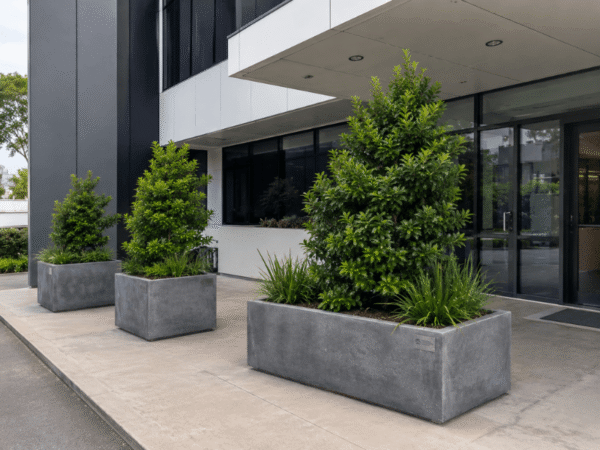
Evergreen trees for containers don’t have that problem. They hold their foliage, their form, and their function across every season — which is why they’re the more reliable choice for most commercial projects, public spaces, and high-end residential settings where year-round performance is part of the brief.
This guide covers the best potted evergreen trees suited to Australian conditions, what makes them work in containers, and where deciduous options still have a legitimate role. For more related resources, please visit our comprehensive Tree Planters Guides Hub.
Evergreen vs Deciduous Trees in Pots: Which Is Right for Your Project?
Evergreen trees in pots maintain foliage through all seasons, delivering consistent greenery, screening, and structure year-round. This makes them the preferred choice for high-traffic commercial settings, entry statements, permanent screens, and any project demanding uninterrupted visual impact.
Deciduous trees in containers offer seasonal drama — spring blossom, autumn colour — and bare winter silhouettes can be striking when the tree has strong architecture. Japanese maples, ornamental pears, and certain magnolias work well as seasonal features in temperate cities.
The trade-off: deciduous container trees require careful planning around their off-season appearance. A bare-branched specimen on a hotel forecourt in July reads as neglect to most clients. For public spaces, building entries, and commercial streetscapes, evergreen trees are almost always the more practical and visually reliable choice.
For projects that can accommodate both, a layered approach works well — evergreen trees anchoring the framework with deciduous specimens as occasional accents. Think of evergreens as the bones and deciduous trees as the jewellery.
What Makes a Good Container Tree?
Not every tree that performs well in the ground translates to pot culture. For a tree to succeed long-term as a potted evergreen, it needs a few key characteristics:
- Moderate root behaviour. Trees with aggressively spreading surface roots — many eucalypts, some figs — can crack containers, destabilise installations, and become a maintenance liability. The best outdoor trees for containers tend to have compact, manageable root systems.
- Tolerance of restricted soil volume. Container trees are working with a fraction of the soil a ground-planted specimen would access. Varieties that are naturally adapted to dry, nutrient-poor, or shallow conditions often transition to container life more readily.
- Climate suitability. Australia’s climate diversity — from subtropical Queensland to cool-temperate Tasmania — means no single list applies everywhere. The selections below are noted with their climate suitability, and local conditions should always inform final plant selection.
- Appropriate scale. A tree that reaches 15 metres in the ground doesn’t belong in a pot, even a large one. The best small evergreen trees for pots are those that are either naturally compact or respond well to formative pruning and root restriction without losing their vigour.
The Best Evergreen Trees for Containers in Australia
Ficus hillii ‘Flash’ (Hills Weeping Fig)
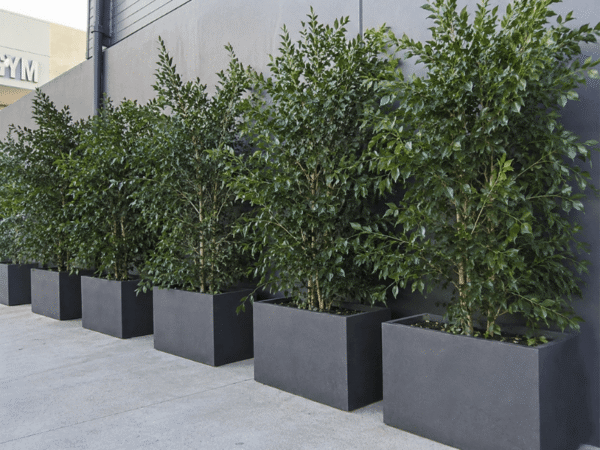
A widely specified evergreen screening tree across eastern Australia. Produces dense, upright growth with glossy, narrow foliage that holds its form exceptionally well under pruning. Columnar habit makes it ideal for tight spaces requiring height without lateral spread.
- Climate suitability: Tropical, subtropical, and warm-temperate zones. Sustained temperatures below 5°C cause significant leaf drop; frost below 0°C can kill young specimens.
- Pot size: Minimum 600mm diameter; 800mm+ for premium installations.
- Design note: Works well in repeated groupings along boundaries or as formal avenues. Suits contemporary and minimalist projects.
Lilly Pilly (Syzygium species and cultivars)

The genus that defines evergreen container trees in Australia. Extraordinary range of cultivars — from compact hedge-ready forms to upright screening varieties — making them among the most adaptable trees for pots. Varieties like Syzygium ‘Select Form’ and Syzygium paniculatum ‘Allyn Magic’ offer fresh pink-copper new growth, dense foliage, and genuine tolerance of container conditions.
Colourful new growth flushes add seasonal interest without the structural void of deciduous trees. Responds well to pruning and can be maintained at consistent height over time.
- Climate suitability: Adaptable across most of the eastern seaboard. Some cultivars handle light frosts; check variety-specific tolerance for southern projects.
- Pot size: 500mm minimum; 600–800mm for screening specimens above 2 metres.
- Design note: Excellent for privacy screening. Repeated planting along fence lines creates cohesive, high-impact screens effective every season.
Olive (Olea europaea)
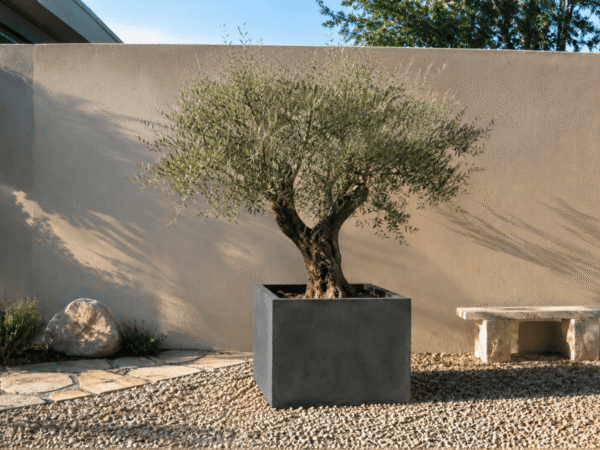
A well-established olive in a large pot is an instant piece of living sculpture — the gnarled trunk, silvery-green foliage, and year-round presence make it one of the best trees for pots outdoors in warm to dry climates. Standard-form specimens work particularly well in contemporary residential and hospitality settings, and drought-tolerance makes it sensible where irrigation may be inconsistent.
Fruiting varieties produce olives in the right conditions. For public spaces, sterile or low-fruiting varieties like ‘Tolley’s Upright’ or ‘Swan Hill’ are worth specifying.
- Climate suitability: Mediterranean-climate zones (Perth, Adelaide) and warm-temperate areas. Less suited to humid subtropical conditions.
- Pot size: 600mm minimum for standard forms.
- Design note: A pair flanking an entry gate is a landscape design cliché — but it works. Select specimens with character and pair them with containers of appropriate quality and scale.
Japanese Blueberry (Elaeocarpus decipiens)

An underutilised tree deserving more attention. Produces dense, oval to pyramidal growth with deep green, glossy foliage that takes on striking red tones on older leaves before they drop — a subtle seasonal display that doesn’t compromise the overall evergreen structure.
Naturally compact and responds well to container conditions. Upright form suits entries, courtyards, and situations requiring a formal evergreen without the more aggressive growth of some ficus varieties.
- Climate suitability: Subtropical and warm-temperate zones. Suitable for much of the eastern seaboard.
- Pot size: 500–700mm for well-maintained specimens.
- Design note: Works as a softer alternative to more architectural choices. Suits contemporary, tropical-contemporary, and resort-style projects.
Kentia Palm (Howea forsteriana)
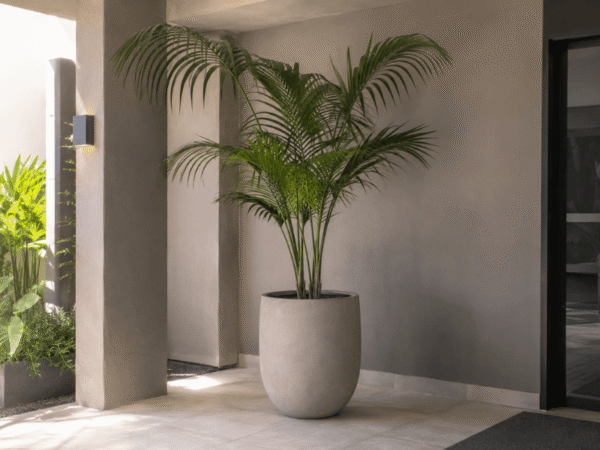
Strictly speaking a palm rather than a tree — but earns a place on any list of the best evergreen trees for pots outdoors in Australia. Graceful, slow-growing, remarkably tolerant of shade and neglect, and one of the few palms that performs as well indoors as outside.
For commercial projects — hospitality venues, retail environments, residential lobbies with outdoor access — the Kentia is almost without rival. Provides tropical year-round structure without intensive maintenance, and ages well in a container over many years.
- Climate suitability: Tolerates wide light range but performs best in sheltered positions. In exposed, windy, or full-sun situations it can look tattered. Handles light frosts but prefers protection from severe cold.
- Pot size: 400mm for smaller specimens; 600mm+ for feature-scale plants.
- Design note: A Kentia in a quality concrete or GRC planter reads as effortlessly curated. Suits hospitality, premium residential, and high-end commercial settings.
Photinia (Photinia × fraseri ‘Red Robin’)
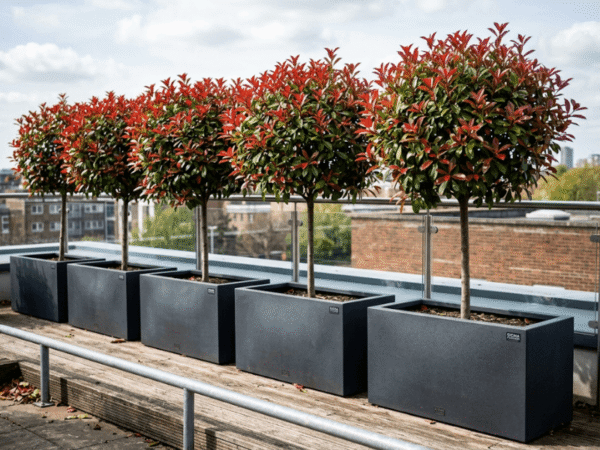
More commonly used as hedging, but as a standard-form container tree it’s genuinely attractive for evergreen screening, particularly in cooler climates where suitable species narrow. Vivid red new growth is a seasonal highlight; deep green mature foliage provides genuine privacy screening.
Responds well to formative pruning, allowing shaping and consistent height maintenance. Standards in large pots work well for rooftop gardens, courtyards, and applications in Melbourne, Canberra, or Hobart where hardiness is a consideration.
- Climate suitability: Best in temperate and cool-temperate climates. One of the more cold-tolerant options on this list.
- Pot size: 500mm+; larger for screening applications.
- Design note: Not the most exotic choice, but reliable. Works in formal and traditional contexts where a tidy, structured appearance is required year-round.
Cumquat (Fortunella species)
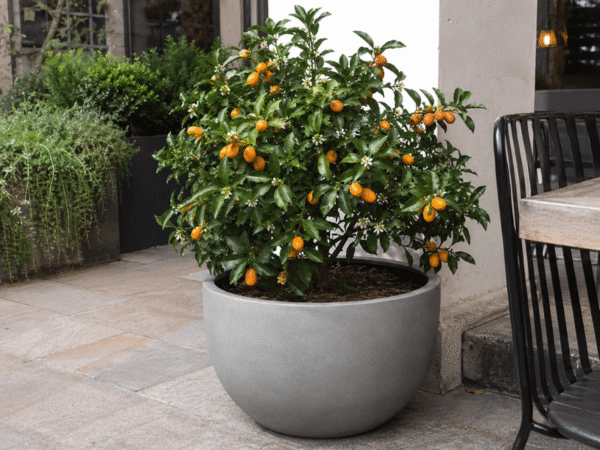
For smaller-scale projects, residential courtyards, or where a productive container tree is part of the brief, the cumquat is genuinely attractive. Dense dark green foliage, fragrant white blossom, and persistent bright orange fruit create interest across multiple seasons without losing structure.
Naturally compact — one of the better small evergreen trees for pots — and tolerates constrained root environments well. Responds to pruning and can be maintained as standards for a more formal appearance.
One caveat: citrus are heavy feeders. Cumquats in pots need fertilising every six to eight weeks through the growing season with citrus-specific fertiliser, and will show displeasure — yellowing leaves, poor fruit set — if nutrition lapses.
- Climate suitability: Subtropical and warm-temperate zones. Protect from heavy frost.
- Pot size: 400–500mm is adequate for long-term pot culture.
- Design note: Excellent for residential courtyards, restaurant terraces, and hospitality settings where a productive, scented, and visually interesting plant adds experiential value.
For broader productive planting ideas, citrus in garden pots can bring fragrance, fruit, and year-round structure to courtyards and hospitality spaces.
Soil, Drainage, and Container Selection
The best plant selection in the world won’t perform if the fundamentals aren’t right.
Potting mix: Use a premium, well-draining potting mix — not garden soil or cheap bagged compost. For trees in pots, a mix incorporating perlite or coarse sand improves drainage and reduces the risk of waterlogging, which is the primary cause of container tree failure.
Drainage: Every container tree needs unobstructed drainage. Pots without drainage holes, or drainage holes that become blocked with root material, lead to anaerobic conditions in the root zone and eventually to irreversible decline. For large planters, consider raising the pot on risers to ensure drainage exits cleanly.
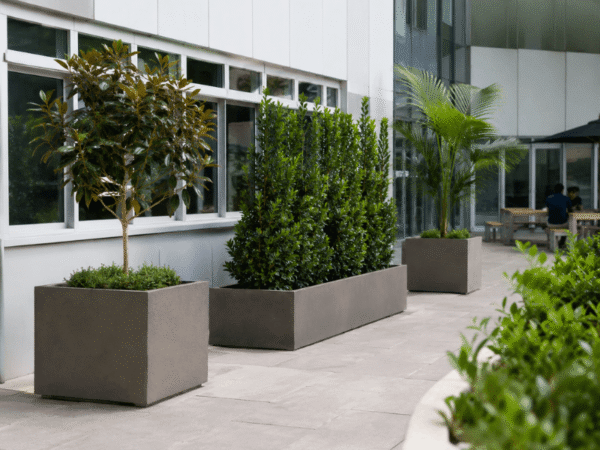
Container size and material: Extra-large planters are not a luxury for container trees — they’re a practical requirement. Undersized containers limit root development and accelerate the stress that leads to poor performance. Lightweight concrete-finish and GRC planters are a popular choice for commercial projects: they deliver the visual weight and neutral backdrop that lets the plant take centre stage, without the structural loading concerns of solid concrete — an important consideration for rooftop and elevated installations.
Irrigation: Container trees dry out faster than ground-planted specimens, particularly in summer. A drip irrigation system connected to a timer is the most reliable way to maintain consistent moisture — especially on commercial sites where manual watering is impractical
Specifier note: Our commercial tree planters are built to support large soil volumes, mature root systems, and exposed public-space conditions.
Maintaining Structure Over Time
Evergreen trees in containers don’t look after themselves indefinitely, but their maintenance needs are predictable and manageable.
Formative pruning in the first two to three years sets the tree’s structure and determines how it will perform in maturity. Annual feeding with a slow-release fertiliser in spring, supplemented with a liquid feed through the growing season, maintains vigour. Repotting every three to five years — or root pruning in situ for trees that can’t be easily moved — prevents the pot from becoming completely root-bound.
Container trees that are well-established and well-maintained will often outperform their ground-planted counterparts in small spaces, simply because the constrained root zone focuses the plant’s energy into above-ground growth.
The Specifier’s Verdict
A container planting that looks good in year one and deteriorates by year three is a specification failure, not a maintenance failure. The species was wrong for the climate, the pot was undersized, or the drainage was never going to work. Evergreen trees for containers are long-term investments — they should still be performing a decade after installation, anchoring the space with the same structure and presence they delivered on day one.
That outcome doesn’t happen by accident. It comes from matching species to climate with precision, specifying containers at the right scale, and understanding the individual requirements of each plant well enough to brief the maintenance team correctly. The trees on this list are capable of delivering that longevity. Whether they do depends entirely on the rigour of the specification behind them.
Explore our collection of tree planters — built for specimen trees and large-scale landscaping.

0 Comments