


There’s a reason olive trees have been cultivated for thousands of years. Long-lived, architecturally striking, and surprisingly unfussy, Olea europaea brings an effortless Mediterranean quality to any outdoor space — and it does so remarkably well in a large container.

Growing olive trees in containers has become a genuine design staple across Australian commercial and residential projects. From resort pool decks to inner-city courtyards and high-end residential terraces, large potted olive trees have become a go-to choice for landscape designers who want structure, longevity, and visual impact in a single plant. This guide covers everything you need to get it right: variety selection, pot choice, soil, watering, feeding, pruning, and the particular quirks of Olea europaea care in the Australian climate.
This post falls under our resource hub for Potted Species Growing Guides.
Why Olive Trees Work So Well in Containers
The appeal of mature olive trees is partly aesthetic: their silvery-grey foliage, gnarled trunks, and fine-textured canopies create a sculptural presence that complements rendered concrete, natural stone, and timber – staples of contemporary Australian design.
But beyond good looks, potted olives also give landscape architects and designers a level of flexibility that in-ground planting simply can’t offer. They can be positioned to frame an entrance, anchor a terrace, or define a boundary, and relocated if a project evolves. Their natural hardiness – thriving in dry summers, poor soils, and coastal winds – translates well to pots, making them a forgiving, reliable choice for commercial projects where consistent health is key. Moreover, as an evergreen tree, the olive maintains its striking silver-grey canopy throughout the year, providing uninterrupted structure and a constant Mediterranean ambience even in the depths of winter.
Choosing the Right Variety for Container Growing
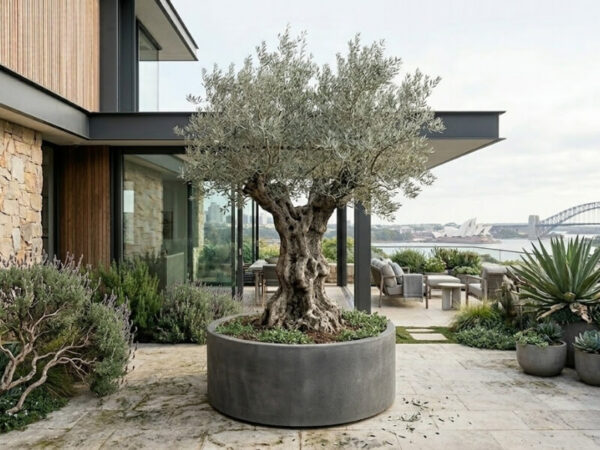
Not all olive varieties perform equally well in pots. Some are bred primarily for fruit production, with vigorous root systems that quickly overwhelm containers. For container gardening, prioritise varieties that are more compact and ornamental in habit.
Arbequina is one of the most popular container choices globally. It has a naturally compact, weeping canopy, produces small fruit, and adapts well to restricted root space. It’s also one of the more cold-tolerant varieties.
Frantoio grows more upright and is prized for its elegant form. It tolerates container life well and produces quality fruit as a bonus.
Swan Hill is a particularly practical ornamental choice for commercial and residential projects — it produces minimal pollen and virtually no fruit, which eliminates the messy drop issue that makes some clients hesitant about olive trees in public-facing spaces.
Little Ollie (a dwarf cultivar) is another excellent option where a more compact footprint is needed. It suits smaller pots and tight urban spaces while maintaining the characteristic olive aesthetic.
For large potted olive trees intended as feature specimens, semi-mature trees with established trunks and canopies are widely available through specialist nurseries across Australia. These command a significant investment, so getting the growing conditions right from the start matters.
| Variety | Growth Habit | Fruit Production | Best Suited For |
| Arbequina | Compact, weeping | Small, heavy yields | Cold climates, medium pots |
| Frantoio | Upright, open, elegant | Medium to large fruit | Classic Mediterranean look, harvesting |
| Swan Hill | Balanced, robust | None (Sterile) | Public spaces, pristine paving, poolsides |
| Little Ollie | Dwarf, dense, compact | None to minimal | Balconies, low hedges, small courtyards |
For narrow spaces that need height and privacy rather than a compact feature tree, Slender Weaver bamboo in linear troughs can provide a denser screening option.
Selecting the Right Pot

Pot selection is where many otherwise well-intentioned olive plantings go wrong. The wrong container will undermine even the most attentive care. An oversized container, for example, holds too much moisture—a fast route to root rot. Olives thrive when slightly root-bound. Start an established tree in a 50–60 cm pot. As the tree matures and the roots fill the container, step up to larger pots — 70–80 cm or beyond for substantial specimen trees.
And drainage is non-negotiable. Olives are highly susceptible to root rot in waterlogged conditions. The pot must have generous drainage holes, and those holes must remain clear. Avoid pots with a single small drainage hole, particularly for large trees that receive heavy watering or are exposed to rain.
Lastly, for the material: lightweight concrete planters are a popular and practical choice — they offer the neutral, muted aesthetic that complements olive foliage beautifully, and they’re durable enough for long-term outdoor use without the weight penalty of solid concrete. Terracotta is a classic pairing aesthetically but dries out quickly and can crack in frost-prone areas. Powder-coated steel and GRC (glass reinforced concrete) planters are increasingly popular for commercial and high-end residential projects where longevity and design consistency are priorities.
Specifier note: For mature olive trees and other large potted specimens, explore our lightweight concrete planters built for strength, stability, and long-term outdoor performance.
Soil and Potting Mix
Olive trees thrive in free-draining, relatively infertile soils — and pot culture is no different. Avoid standard potting mixes designed for moisture retention. Use a premium potting mix amended with coarse perlite or horticultural grit to keep drainage fast and the root zone well-aerated. A neutral to slightly alkaline pH (6.5–8.0) suits them well. Skip the high-nitrogen slow-release fertilisers at planting; olive trees don’t need rich soil, and excess nitrogen drives leafy growth at the expense of flowering.
Watering a Potted Olive Tree
Overwatering is the most common mistake. Olive trees are drought-tolerant by design, and in containers they need to dry out between waterings — not sit in consistently moist mix. Water deeply, then hold off until the top few centimetres of potting mix are genuinely dry. In summer, a well-established specimen in a large container will typically need watering every five to seven days. In winter, reduce to fortnightly or less in cooler regions. A degree of drought stress actually encourages better flowering, so resist the urge to keep the mix damp year-round. For commercial installations, a drip irrigation system set to the right frequency removes the guesswork.
Feeding
Keep it light. A single application of balanced slow-release fertiliser in early spring is sufficient for most potted olives. Avoid high-nitrogen formulations — if you want to encourage flowering, choose something with a higher phosphorus and potassium ratio. In warmer climates, a second light feed in late summer can help; in cooler southern states, spring alone is enough. Yellowing foliage sometimes indicates magnesium deficiency in older containers where nutrients have leached out — a foliar spray of Epsom salts will resolve it quickly.
Sunlight
Full sun is essential. Olive trees in pots need a minimum of six to eight hours of direct sunlight per day to perform well. Insufficient light leads to sparse foliage, poor flowering, and a generally leggy, unthrifty appearance.
In the arid interior or in exposed coastal sites, some afternoon shade during the peak of summer can help prevent leaf scorch on younger specimens, but established olives in good health generally handle full sun well. For most Australian settings — particularly the capital cities and their surrounding regions — full, unobstructed sun is ideal.
Pruning and Shaping
Olive trees respond well to shaping and are easy to maintain. Most commercially available specimens are already grown as standards — a clear trunk with a rounded canopy — and keeping that form tidy is straightforward. Prune lightly in late winter or early spring before new growth begins: remove crossing or dead branches, clear any suckers from the base, and tip the outer canopy to encourage density. Avoid heavy pruning in autumn; it stimulates new growth that can be caught by cold in southern regions. Whether you’re maintaining a formal standard or a more naturalistic multi-stemmed form, the principle is the same — keep the centre open, remove crowded growth, and don’t cut back into old wood that isn’t actively shooting.
For more container growing advice, explore our pot planting and care guides.
Cold and Frost Considerations
Most Olea europaea varieties can tolerate light frosts down to around -5°C to -7°C once established — but container-grown trees are more vulnerable than those in the ground, because the roots are exposed to ambient air temperature rather than insulated by the soil.
In Melbourne, the Adelaide Hills, or parts of the NSW highlands, winter protection may be warranted during cold snaps:
- Move containers into a sheltered position (against a north-facing wall, for example) during the coldest weeks.
- Protect the pot itself by wrapping in hessian or relocating to an undercover area, which reduces how cold the root zone gets.
- Avoid moving trees inside heated spaces — the contrast in conditions causes stress.
Young trees are more susceptible than mature specimens. In frost-prone locations, consider over-wintering smaller trees under cover until they’ve developed enough woody growth to handle cold weather reliably.
Climate Considerations in Australia
Olive trees are well-adapted to most of Australia’s populated coastal regions. They thrive in the Mediterranean-style climate of Perth and Adelaide, perform reliably in Sydney, and grow well in Melbourne and the cooler parts of Victoria with a little winter protection for young plants.
In subtropical Queensland, olive trees can be grown successfully in containers, though they may not fruit as prolifically due to the absence of sufficient winter chilling hours. For commercial and decorative applications where fruit production isn’t the goal, this is rarely a concern — the foliage and form remain excellent year-round.
In the tropical north, olives are not the right choice. Heat, humidity, and a lack of cool winters combine to make sustained healthy growth difficult in Darwin, Cairns, or the Kimberley. Better to choose a plant naturally suited to that environment than to fight the climate.
In warmer, humid regions, lemon myrtle can be a more climate-suited aromatic tree option. For productive container planting in milder coastal areas, citrus in garden pots can also bring fragrance, fruit, and year-round structure.
For exposed coastal sites, olives are a genuinely excellent choice — they’re salt-tolerant and handle wind far better than most ornamental trees.
Repotting Large Potted Olive Trees

Olive trees don’t need frequent repotting. In fact, disturbing the roots too regularly can set a tree back significantly. A good rule of thumb is to repot only when the tree shows clear signs of being root-bound: roots emerging from drainage holes, noticeably reduced growth, or rapid drying of the potting mix.
When repotting, choose a pot only slightly larger than the current one — 10–15 cm larger in diameter is sufficient. Spring is the best time, just as new growth begins. Gently tease out any circling or compressed roots at the base before replanting, use fresh potting mix prepared as above, and water in thoroughly before allowing the mix to dry significantly before the next watering.
For very large specimen trees, top-dressing — removing the top 5–8 cm of old potting mix and replacing with fresh mix — is a practical alternative to full repotting and can be done annually in spring.
Common Problems and Solutions
- Yellowing leaves: Usually a sign of overwatering, poor drainage, or nutrient deficiency (particularly magnesium or iron). Check drainage first, then adjust feeding accordingly.
- Leaf drop: Some seasonal leaf drop is normal in cooler months. Sudden, significant leaf drop in warmer months generally points to root disturbance, waterlogging, or extreme temperature stress.
- Sooty mould and scale: Olive lace bug and various scale insects can affect potted olives, particularly in humid conditions. Treat with horticultural oil or neem oil and improve airflow around the pot.
- Poor flowering or fruiting: Almost always caused by insufficient sunlight, overwatering, or excessive nitrogen. Relocate to a sunnier position and reassess your feeding regime.
Long-Term Investment
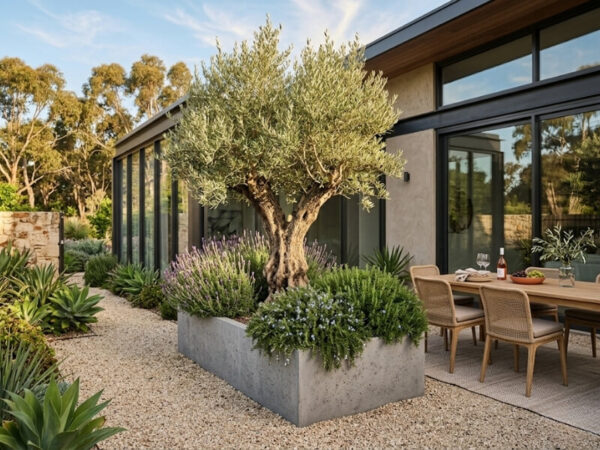
What sets the olive tree apart as a container plant is its longevity. A well-cared-for potted olive will outlast most other ornamental plants by decades — becoming more characterful and visually interesting with age, not less. The gnarled, textured trunk of a mature specimen is impossible to replicate quickly, which is why established large potted olive trees command a premium and hold their value in landscape and property terms.
For another long-term architectural specimen, potted dragon trees offer a more sculptural, prehistoric form for premium courtyards, terraces, and commercial landscapes, while the native specimen tree, Brachychiton rupestris, adds a bolder trunk form and distinctly Australian character to large planter settings.
Get the fundamentals right — a well-draining container, an appropriate potting mix, restrained watering, and full sun — and you’re investing in a plant that will reward you for years to come.
0 Comments