


There’s a particular kind of heat that settles over an Australian patio by mid-afternoon in January, the kind that sends everyone scrambling indoors regardless of how nice the outdoor furniture looks. A pergola helps. A shade sail helps more. But nothing softens a hot, hard-surfaced courtyard quite like a tree, and for many sites, an in-ground tree simply isn’t an option. This is where container shade trees earn their keep.
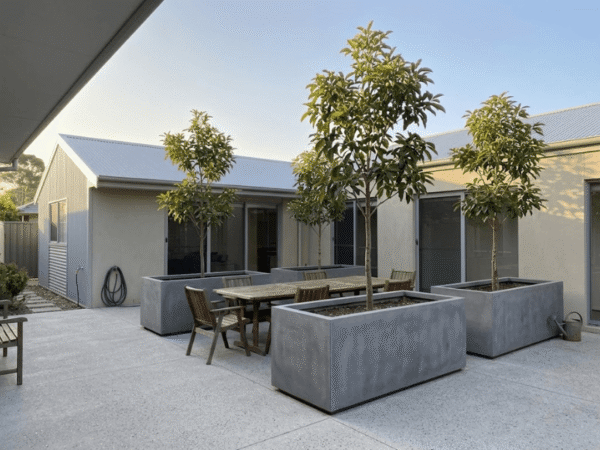
Choosing shade trees for pots is a different exercise to choosing trees for the open garden. Root space is finite, exposure is often more intense thanks to reflected heat off paving and walls, and the tree needs to perform as both a functional sunscreen and a year-round design feature. Get the selection right, and a single well-placed specimen can drop the ambient temperature of a courtyard by several degrees while doing more for the look of the space than almost any other single element you could add.
This guide runs through the best broad-leafed trees for hot Australian patios, what makes a tree genuinely suited to pot life, and how to set your specimen up to thrive rather than merely survive. And if you’re looking to expand your knowledge further, our Tree Planters Guides Hub is packed with practical guides on everything from root pruning to seasonal feeding for a wide range of tree species.
What Makes a Tree Suitable for Pots in the First Place
Not every tree that’s marketed as “compact” or “patio-friendly” actually performs well in a container long-term. Before getting into specific varieties, it’s worth understanding the traits that separate a genuine container shade tree from one that will outgrow its pot, sulk in the heat, or demand more water than most patios can realistically provide.
A naturally restrained root system. Trees with fibrous, well-behaved roots cope far better with confinement than those that send out aggressive lateral roots in search of moisture.
Tolerance of root restriction. Some species respond to a confined root zone by simply slowing their growth rate, which is exactly what you want. Others become stressed and drop leaves or stop flowering.
Reasonable drought tolerance. Even with diligent watering, pots dry out faster than garden beds, particularly in full sun on a paved courtyard where reflected heat adds to the load.
A manageable mature size, or a willingness to be pruned. A tree that wants to be 15 metres tall will fight you every year if it’s confined to a 60cm pot.
Broad, dense foliage. For genuine shade rather than dappled relief, you want a canopy that casts real cover, not a tree with sparse, narrow leaves that lets most of the sun through anyway.
Specifier note: Our commercial tree planters are built to handle the soil volume, root mass, and environmental stress that potted shade trees demand in hot Australian courtyards.
The Best Shade Trees for Pots on Hot Patios
Magnolia ‘Little Gem’ (Magnolia grandiflora ‘Little Gem’)

A dwarf cultivar of the classic Southern magnolia, ‘Little Gem’ delivers the same glossy, broad evergreen foliage and creamy, fragrant flowers as its full-sized relative, but in a far more pot-friendly package, typically reaching 4-6 metres in a container over many years rather than the 20-plus metres of the species. The thick, leathery leaves cope well with harsh sun and wind, and the tree holds its shape with minimal pruning. This is a genuine feature tree for pots, equally at home flanking a front entrance or anchoring the corner of a courtyard.
Frangipani (Plumeria species)
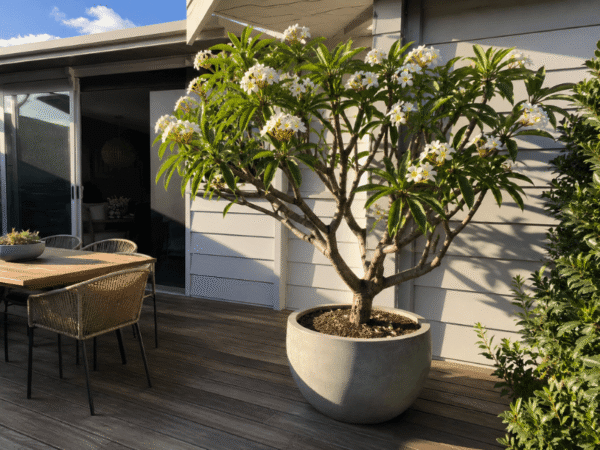
We’ve covered frangipani as a Brisbane garden staple elsewhere on this site, and its credentials as a potted patio tree hold up across most of Australia’s warmer zones. The broad, paddle-shaped leaves provide reasonable canopy cover during the growing season, and the sculptural branch structure adds visual interest even in winter when the tree drops its leaves. Frangipanis are remarkably drought-tolerant once established and genuinely thrive on a degree of neglect, which makes them one of the lowest-maintenance ornamental shade trees available to pot gardeners.
For more ideas on flowering trees in pots, including species chosen for colour and fragrance, see our guide to creating a flowering container display.
Crepe Myrtle (Lagerstroemia indica and hybrids)
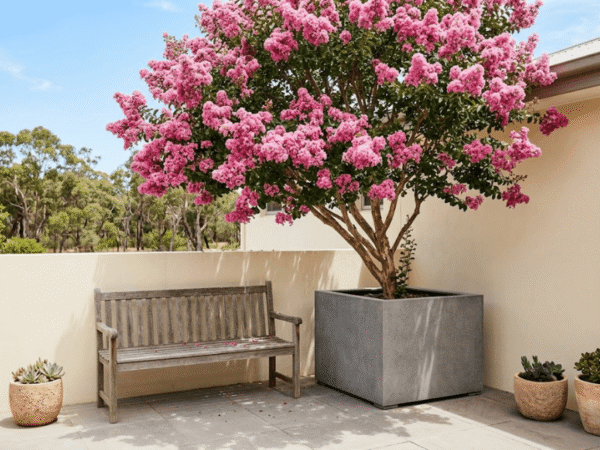
Dwarf and semi-dwarf crepe myrtle varieties are increasingly popular as patio trees in pots, and for good reason. They tolerate heat and reflected glare without complaint, put on a spectacular floral display through summer, and many varieties offer rich autumn foliage colour as a bonus. Look for compact cultivars bred specifically for container use rather than standard garden varieties, which can quickly outgrow a pot. Crepe myrtles are deciduous, so they won’t provide year-round shade, but the trade-off is welcome winter sun on a patio that needs it.
Japanese Maple (Acer palmatum)
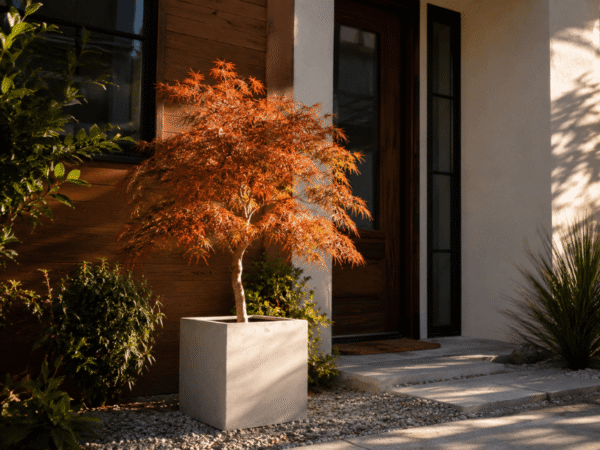
For cooler and temperate zones in particular, Japanese maples remain one of the most popular feature trees for pots, and broad-leafed cultivars with a more spreading habit can provide reasonable dappled shade alongside genuine seasonal drama. They’re not the toughest option for harsh, exposed western sun in the hottest parts of the country, but in a courtyard with some protection from the worst of the afternoon heat, a Japanese maple delivers a level of refinement few other options can match. Filtered light and shelter from drying winds will keep the foliage in better condition.
Lilly Pilly (Syzygium species, standard or topiary form)
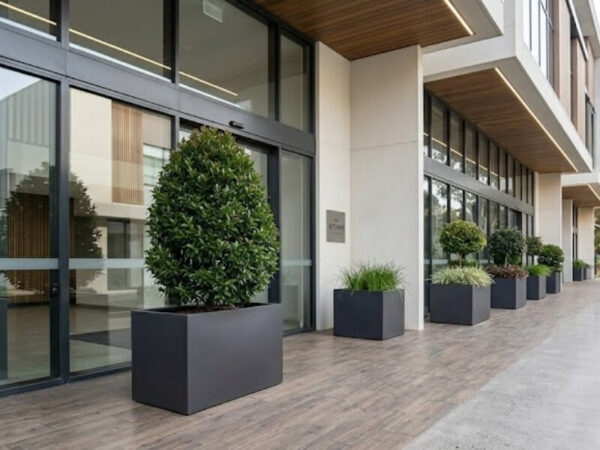
Lilly pilly is already a favourite for screening and hedging in Australian gardens, and trained into a standard or lollipop form, it doubles as a dense, broad-canopied shade and screening tree in pots. The fine-leafed varieties make excellent topiary, while the broader-leafed cultivars provide more substantial shade cover. Be aware that lilly pilly does produce fruit, which can be messy on hard paving directly beneath the canopy, so it’s worth siting away from outdoor dining areas or selecting a lower-fruiting variety.
Tuckeroo (Cupaniopsis anacardioides)
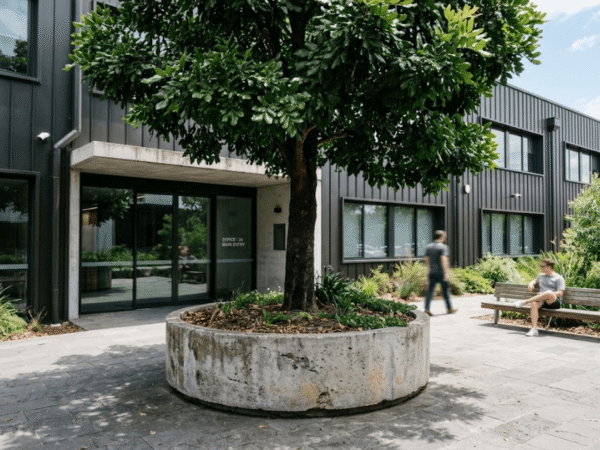
An Australian native that’s increasingly specified for commercial courtyard trees thanks to its dense, glossy canopy and genuine resilience in hot, exposed, coastal-adjacent conditions. Tuckeroo handles wind, salt, and reflected heat without fuss, making it a strong choice for rooftop terraces, commercial forecourts, and any patio that copes with harsh afternoon exposure. It’s a slower grower in a container, which works in its favour for long-term pot suitability.
Weeping Lilly Pilly / Waterhousea floribunda
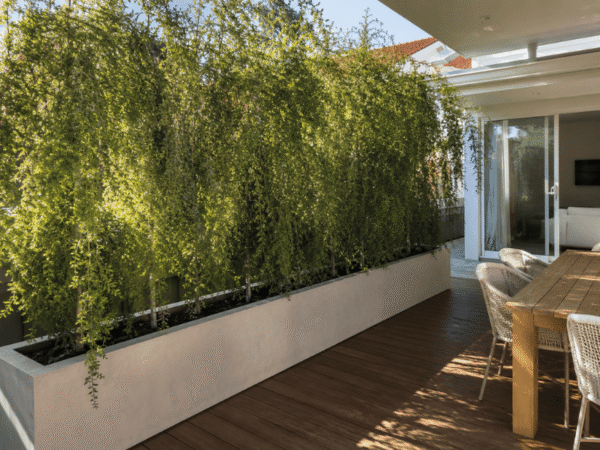
Where more dramatic, weeping canopy coverage is the goal, Waterhousea offers a softer, more graceful silhouette than the upright lilly pilly forms while still delivering dense, broad-leafed shade. It’s a popular choice for screening trees in pots along boundary lines or beside outdoor entertaining areas, where the cascading foliage also muffles noise and softens hard architectural lines.
Olive (Olea europaea)
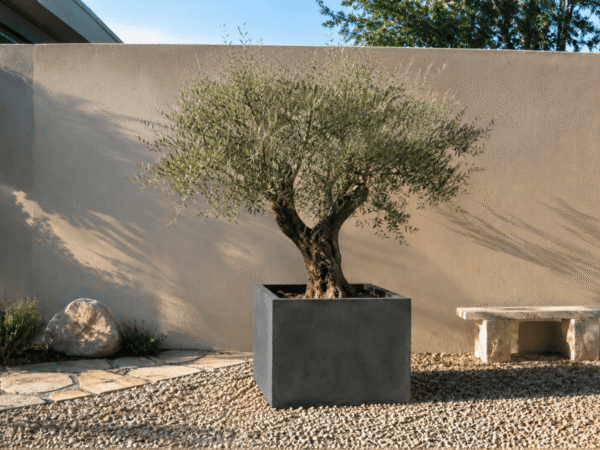
Olives are something of an unsung hero among patio trees in pots. The silvery, broad-ish foliage handles full, blasting sun with ease, the root system is well-suited to confinement, and a mature specimen in a large planter brings a Mediterranean character that pairs beautifully with citrus, lavender, and other sun-loving companions. Olives are evergreen, slow-growing in pots, and genuinely thrive on the kind of tough love that would stress out more delicate species.
Kaffir Lime and Other Citrus Standards
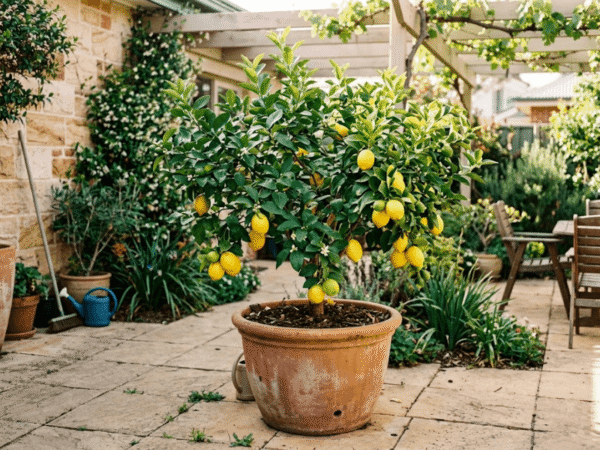
We’ve written at length about growing citrus in pots, and a well-trained citrus standard does double duty as both a productive plant and a genuine source of dappled shade. Calamondin and Meyer lemon, in particular, hold dense, glossy foliage that copes well with reflected courtyard heat, and the bonus of fragrant blossom and homegrown fruit makes citrus one of the more rewarding options on this list for residential patios.
Bottle Tree (Brachychiton rupestris)
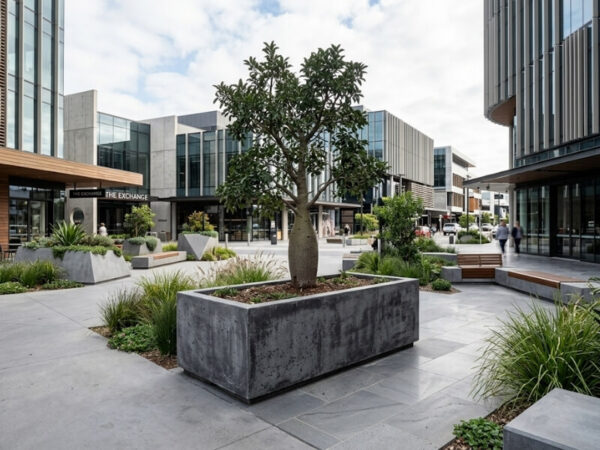
For a genuine architectural statement, the Queensland bottle tree is hard to beat. Its distinctive swollen trunk and broad, glossy canopy make it one of the more striking ornamental shade trees available, and it’s exceptionally drought-tolerant thanks to its trunk’s natural capacity to store water. Growth in a container is slow, which suits long-term patio use, though it does need a generously sized, sturdy planter to balance the visual weight of that signature trunk.
Matching the Tree to the Site
Selecting the species is only half the job. The conditions on your particular patio will shape which of these options performs best.
North and west-facing courtyards see the most intense afternoon sun and the highest reflected heat off paving, so prioritise genuinely tough, drought-tolerant options like olive, tuckeroo, frangipani, or bottle tree.
Coastal or rooftop sites need to factor in wind exposure and, in coastal cases, salt tolerance. Tuckeroo and lilly pilly both handle these conditions comfortably; Japanese maple does not.
Sheltered courtyards with some midday shade open up the options considerably, allowing for the slightly more delicate Japanese maple or magnolia to shine without the stress of constant, harsh exposure.
Commercial and public-facing sites generally call for the toughest, lowest-maintenance options that can withstand inconsistent watering and a degree of foot traffic. Tuckeroo, olive, and standard lilly pilly are reliable choices for these settings.
For planting around pools, explore our guide to low-litter and pool-friendly trees for suitable options.
Bringing It Together
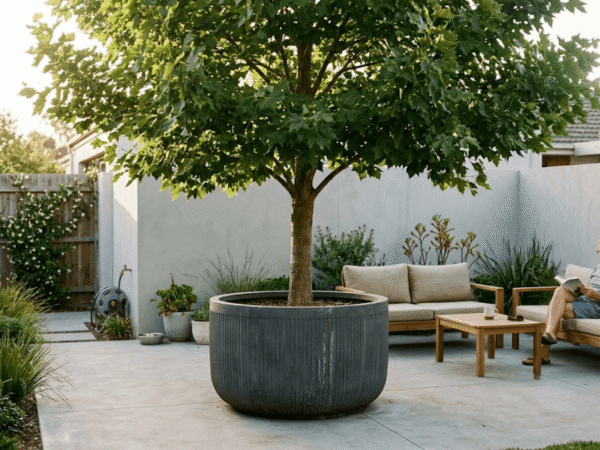
The right courtyard tree does more than throw shade. It softens hard architectural lines, brings movement and seasonal change to a paved space, and gives a patio the kind of presence that furniture and shade sails alone can’t achieve. Whether the brief calls for a single sculptural feature tree for a residential courtyard or a row of tough, low-maintenance specimens for a commercial forecourt, there’s a broad-leafed option suited to almost every hot Australian patio.
The key is matching the tree’s natural toughness and growth habit to the realities of the site, then giving it a planter and a care routine that supports decades of healthy growth rather than just a few good seasons. A well-chosen extra large planter gives your tree the root volume, thermal insulation, and stability it needs to flourish in a hot patio environment – making it one of the most important investments you’ll make in your outdoor space. Get that right, and a potted shade tree becomes one of the most rewarding long-term investments you can make in an outdoor space.
Explore our collection of tree planters — built for specimen trees and large-scale landscaping.

0 Comments