


There’s a particular kind of frustration that comes with skimming the same handful of leaves off a pool surface every single afternoon, only to watch a fresh drift settle in by morning. Anyone who has specified planting around a pool, whether it’s a backyard plunge pool or a resort-style lap pool for a hospitality client, knows that the wrong tree can turn a beautiful feature into an ongoing maintenance headache. Sap on the coping, petals clogging the skimmer basket, roots creeping toward the shell — these are the kinds of problems that show up months after installation, long after the “it looked great in the nursery” stage has passed.
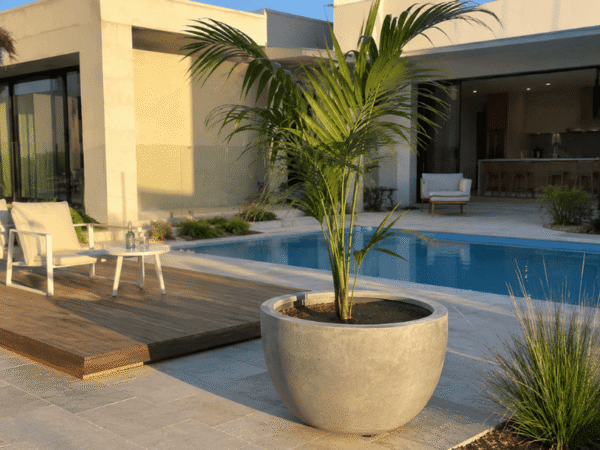
Trees in pots for pool areas solve most of these issues before they start. A well-chosen potted specimen gives you height, shade, and a resort-style backdrop without the root intrusion of an in-ground planting, and it can be swapped out or repositioned if it turns out to be the wrong fit. But pot growing alone doesn’t guarantee a clean pool. The species still matters enormously.
This guide walks through what actually makes a tree pool-friendly, which varieties perform best in Australian conditions, and how to pot and position them so your pool area stays as low-maintenance as the rest of the landscape. For expert advice on selecting the right pot, potting mix, and drainage, visit our Tree Planters Guides in the Resource Hub.
Why Tree Selection Matters More Around a Pool
Planting near a pool isn’t like planting anywhere else in the garden. A few extra considerations come into play that don’t apply to a courtyard bed or a streetscape verge.
- Filtration load: Every leaf, flower, and seed pod that lands in the water either gets skimmed manually or ends up straining your filtration system. Fine debris that breaks down in the water — flower petals, small leaflets, sap — is often worse than the odd large leaf, because it’s harder to net out and can clog cartridge filters over time.
- Slip hazards: Pool decking gets wet, and wet decking covered in fallen leaves, berries, or dropped fruit becomes genuinely dangerous, particularly around the pool edge where people are walking barefoot.
Chemical exposure: Chlorinated splash and reflected heat off the water and paving create a slightly harsher microclimate than a typical garden bed. Some species handle this better than others. - Root behaviour: Even in a pot, some species have roots vigorous enough to eventually crack a container or push through drainage holes if left too long without repotting. This matters more near a pool shell, coping, or paving than it does elsewhere.
- Allergens and irritants: Pool areas tend to be used by bare skin, often for extended periods. Sap, spines, and pollen-heavy blooms are worth avoiding in a space where people are lounging in swimwear.
What Actually Makes a Tree “Pool-Friendly”?
When clients ask for pool-friendly trees, they’re usually describing a combination of the following traits, even if they haven’t put it in these terms:
- Evergreen — no seasonal leaf drop event dumping a season’s worth of foliage into the water at once.
- Low litter — minimal flower, fruit, or seed pod drop, and foliage that doesn’t shed heavily even outside of an obvious “season.”
- Non-messy sap or resin — nothing that leaves a sticky residue on paving or pool furniture.
- Manageable size in a container — a root system and growth habit that stays well-behaved in a pot for several years between repots.
- Thornless and low-allergen — no spines, thorns, or heavily perfumed pollen that could cause irritation poolside.
- Wind and heat tolerant — pool areas are often more exposed and reflect more heat than a typical garden position.
No tree ticks every one of these boxes perfectly, but the varieties below come closest, and they’re all proven performers in Australian conditions.
The Best Trees in Pots for Pool Areas
1. Frangipani (Plumeria species)
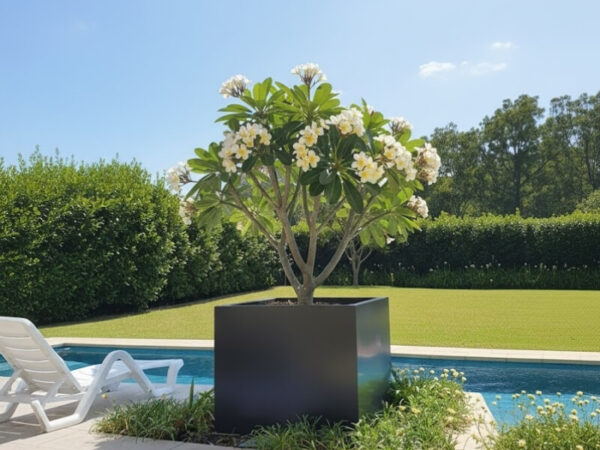
Frangipani is something of a special case. It is semi-deciduous, dropping its leaves in winter, and it does drop spent flowers through the warmer months. However, both the leaves and the flowers are soft, don’t disintegrate in water, and are simple to skim off the surface without clogging a filter. Its sculptural branch structure and fragrant blooms are so closely associated with Australian pool culture that many designers consider the minor cleanup worth it. If a completely litter-free tree is the priority, frangipani isn’t it — but if a low-maintenance, iconic poolside look is the goal, it earns its place on this list.
2. Kentia Palm (Howea forsteriana)
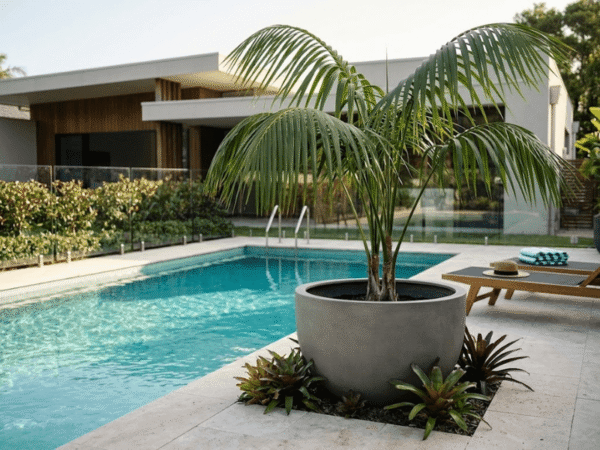
For a resort feel with minimal fuss, the Kentia Palm is hard to beat. Its graceful, arching fronds create instant tropical atmosphere without the mess associated with fruiting palms like the cocos palm. Kentias are slow growing, tolerate part shade as well as full sun, and cope well with the reflected heat and occasional wind exposure that comes with a poolside position. Frond drop is infrequent and the fronds themselves are large and easy to remove in one piece, rather than shedding continuously in small fragments. For more shade-loving potted trees with broader foliage, check out our guide to broad-leafed trees for hot Australian patios.
3. Olive Tree (Olea europaea)

The olive is close to the default choice for a reason. Its fine, silvery-grey evergreen foliage barely sheds, it’s about as drought and heat tolerant as trees get, and its Mediterranean look pairs beautifully with pool coping and stone paving. For a genuinely low-litter option, choose an ornamental or fruitless cultivar — standard fruiting olives will drop a mess of ripe fruit in autumn that stains paving and is a slip hazard underfoot. Olives are also naturally suited to container life; their root systems are relatively restrained, and they actively prefer being slightly pot-bound, which makes them one of the best low-maintenance poolside trees available.
4. Standard Bay Tree (Laurus nobilis)

Clipped into a lollipop or ball standard, the bay tree is an evergreen poolside tree with genuinely negligible litter. Its dense, glossy foliage holds its shape well, it tolerates heat and reflected light without complaint, and a pair of matching standards either side of a pool entrance or cabana creates an immediate sense of formality. Because it responds so well to clipping, it’s easy to keep to a manageable size in a large pot for years.
Specifier note: Great design starts with the right planter. Our commercial tree planters deliver the durability, drainage, and scale needed for poolside trees that thrive – not just survive.
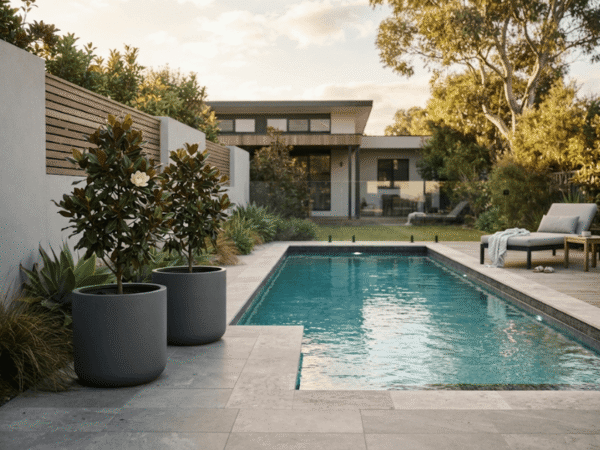
5. Magnolia ‘Little Gem’

This dwarf evergreen magnolia offers something a little more architectural: large, glossy, dark green leaves with a rusty underside, and creamy white flowers over summer. Flower drop is minor compared with deciduous magnolia varieties, and the flowers themselves are substantial enough to be easy to spot and remove rather than disintegrating into fine litter. It performs well in a large pot and provides genuine shade as it matures, making it a strong feature tree for pool areas that want more presence than a clipped standard offers.
6. Podocarpus (Podocarpus elongatus)
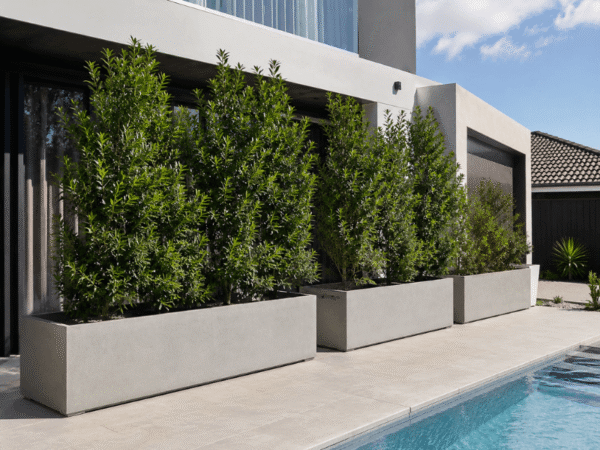
Often used as a clipped hedge or standard, Podocarpus is a conifer-like evergreen with fine, soft foliage that sheds very little. It handles heat, wind, and part shade with ease, and its dense growth habit makes it useful both as a feature specimen and as informal screening around a pool fence line. It’s one of the cleanest options available for anyone prioritising a genuinely low-litter tree over a flowering one.
7. Dwarf Willow Myrtle (Agonis flexuosa ‘Nana’)
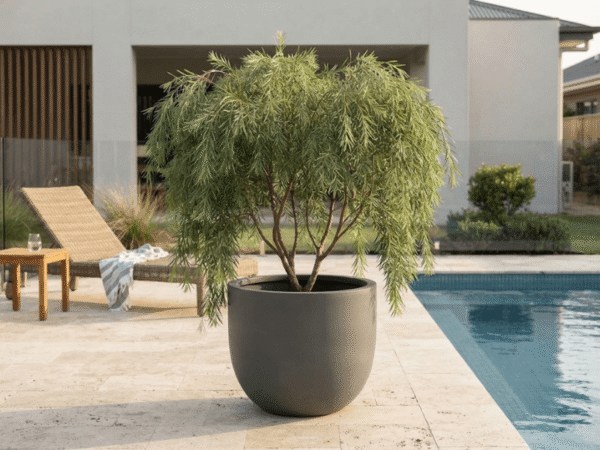
For a native option with soft, weeping form, the dwarf willow myrtle is worth considering. Its fine foliage sheds minimally, it’s naturally suited to Australian heat and dry spells once established, and its cascading habit softens the hard lines of pool coping and paving without the litter load of a native flowering shrub. It stays compact enough for a mid-sized pot and rarely needs more than an annual tidy-up prune.
8. White Bird of Paradise (Strelitzia nicolai)
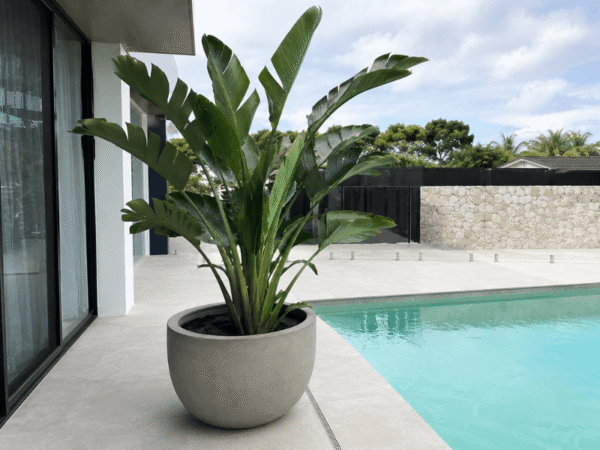
Technically a large, tree-like perennial rather than a true tree, Strelitzia nicolai earns its spot here because it delivers serious architectural impact with almost no litter at all. Its enormous, glossy paddle-shaped leaves occasionally split in wind but rarely drop, and its scale makes it one of the best feature trees for pool areas that want a bold, tropical statement rather than a softer, more traditional look. It’s an increasingly popular choice for hospitality pool decks and resort-style residential builds alike.
Trees to Think Twice About Near a Pool
Anticipating the wrong choice is often as useful as recommending the right one. A few popular species are worth approaching with caution in a poolside position:
- Fruiting palms (e.g. cocos/queen palm): Heavy, messy fruit drop over an extended season, plus a tendency toward self-seeding, makes these a poor fit despite their tropical appeal.
- Jacaranda: Spectacular in bloom, but the sheer volume of sticky, fallen flowers over a short window makes for one of the messier clean-ups a pool owner can sign up for.
- Eucalypts: Bark shedding, gumnuts, and oil-rich leaf litter are a genuine slip and mess hazard on wet decking, and the leaf oil is also a fire consideration close to structures.
- Standard Lilly Pilly: A common hedging and screening choice, but fruiting varieties drop berries that stain and become slippery underfoot, fruit drop is one of the most common reasons a plant gets flagged as unsuitable for high-traffic paved areas. If you love the look, choose a clipped, non-fruiting form and keep it well pruned.
- Deciduous shade trees generally: Anything that drops its entire canopy in a short autumn window is going to overwhelm a pool filtration system, no matter how manageable it looks the rest of the year.
Potting and Placement: Getting the Practical Details Right
Choosing the right species solves half the problem. The other half comes down to how the tree is potted and where it sits relative to the water.
Go large, and go stable. Poolside positions are often exposed to more wind than a sheltered courtyard, and a tall, top-heavy tree in an undersized pot is a tipping hazard as much as an aesthetic problem. Large pots for poolside trees also mean less frequent watering, since a bigger soil volume buffers against the extra evaporation that comes from reflected heat and open sun exposure around a pool deck.
Choose a pool-tolerant material. Lightweight concrete and GRC planters handle chlorinated splash, UV exposure, and reflected heat without fading or degrading, which makes them a sound choice for poolside planters. Their weight also helps with the stability point above, without the impracticality of moving a solid concrete pot once it’s positioned.
Elevate the pot. Sitting a planter directly on paving traps moisture beneath it and can lead to staining or, over time, damage to the pot base. Pot feet or risers keep drainage holes clear, protect the deck surface, and give the base of the pot a chance to dry between waterings — an easy win for keeping a poolside area looking sharp.
Position with the wind in mind. Even a genuinely low-litter tree will drop the occasional leaf or flower. Positioning trees downwind of the pool, rather than immediately upwind, keeps whatever does fall from being blown straight into the water.
Keep root systems contained but not cramped. Repotting every two to three years, or whenever roots start circling the base, prevents any species from outgrowing its container and becoming top-heavy or root-bound in a way that stresses the plant and increases litter through stress-related leaf drop.
Maintenance Habits That Keep a Pool Area Clean
Even the cleanest tree benefits from a bit of routine care:
- Skim the pool surface daily during flowering or any seasonal transition, rather than waiting for visible buildup.
- Prune spent flowers and any damaged foliage promptly, particularly on species like frangipani or magnolia where spent blooms are the main source of litter.
- Avoid overhead irrigation that sprays onto the pool surface or encourages excess leaf drop from moisture stress.
- Check drainage holes and risers periodically to make sure water isn’t pooling under pots, which can encourage algae and mould near the deck.
Choosing Trees That Earn Their Place Poolside
The best trees for poolside pots aren’t necessarily the showiest ones in a nursery — they’re the varieties that hold their leaves, keep their fruit to themselves, and cope with heat, wind, and reflected glare without complaint. An olive, a clipped bay standard, or a Kentia palm in a well-chosen, elevated pot will do more for a pool area’s long-term upkeep than any amount of extra skimming ever will. Choose evergreen, low-litter species suited to your climate, pot them generously, and position them with the prevailing wind in mind, and a pool area can look genuinely resort-worthy without becoming another item on the weekly maintenance list.
Plant selection should also account for local climate and seasonal conditions. For Melbourne gardens, see our guide to outdoor plants for every season.
Explore our collection of tree planters — built for specimen trees and large-scale landscaping.

0 Comments