


Australian native vines have a habit of doing more work than they’re given credit for. Give one a decent pot, something to climb, and reasonably consistent water in its first year, and it will spend the next decade quietly softening a fence, screening a neighbour’s window, or filling a courtyard wall with colour that most exotic climbers can’t match for toughness. For landscape architects and homeowners alike, native climbing plants solve a problem that’s becoming more common: how do you get vertical greenery into a space with no garden bed, using a plant that won’t collapse the first time someone forgets to water it for a fortnight?
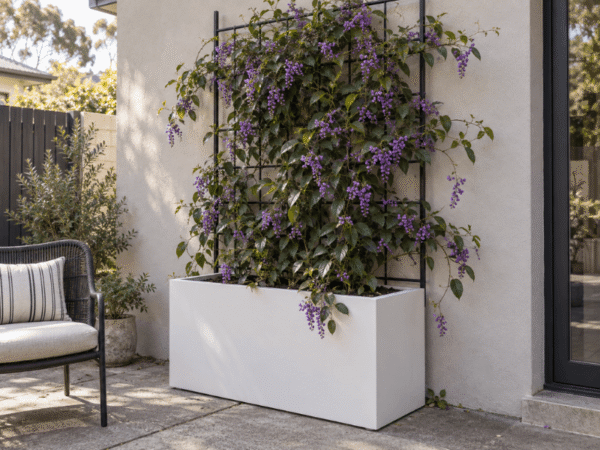
This guide runs through the native climbers that perform reliably in containers — hardenbergia, pandorea jasminoides, wonga wonga vine, kennedia rubicunda, and the plant most nurseries sell as native wisteria — along with the practical detail on pots, support structures, and care that determines whether they thrive or sulk.
For everything on choosing the right pot, potting mixes, drainage, and planter design, see our Garden Pot & Planter Design resource hub.
Why Native Climbers Deserve a Spot on Your Shortlist
Exotic climbers like star jasmine and traditional wisteria get most of the attention in residential planting schemes, and for good reason — they’re reliable performers. But native australian vines bring real advantages in pot culture, where root space and water are already limited. Most evolved in nutrient-poor, free-draining soils, which happens to describe the inside of a pot almost perfectly, so they flower hard without demanding rich mixes or regular fertilising — useful on commercial sites where maintenance visits are tight. Hardenbergia, kennedia, and the pandoreas are also magnets for native bees and a food source for small nectar-feeding birds, and as councils and developers increasingly favour indigenous planting palettes for streetscapes and public realm work, they offer vertical interest without breaking from that brief. That said, a few of the plants below have genuine vigour that needs managing in a container — but for the right selection and application, nothing else outperforms them in a pot against a wall.
Setting Climbers Up to Succeed in Pots
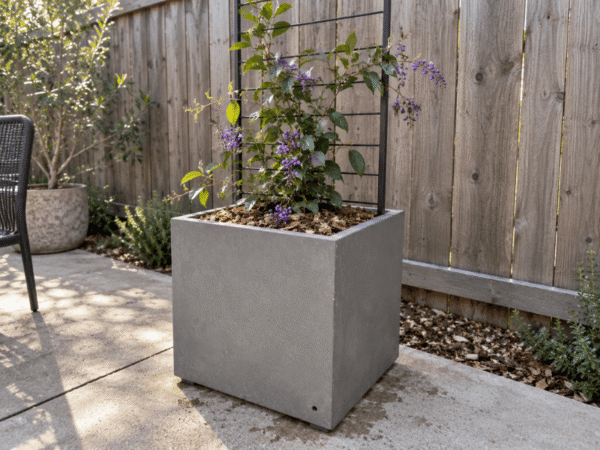
Before getting into individual species, it’s worth covering the groundwork that applies to all of them, because most container climber failures come down to the same handful of mistakes.
Pot Size and Root Space
Climbing plants put a lot of energy into top growth, and that growth needs a proportional root system to sustain it. As a rule of thumb, start with a garden pot at least 40-50cm in diameter and equally deep for any of the vigorous growers on this list. Undersized pots lead to stressed, thirsty plants that flower poorly and are more susceptible to pest pressure.
Drainage Is Non-Negotiable
Every plant covered here needs sharp drainage. Native plants in general are notoriously intolerant of phosphorus-heavy, waterlogged conditions, and climbers are no exception — wet feet will kill a hardenbergia faster than drought ever will. Use a quality potting mix formulated for natives, or amend a standard mix with extra coarse sand or perlite.
Give Them Something to Climb
This sounds obvious, but it’s the detail most commonly overlooked. Each of these species has a different climbing habit, and matching the plant to the right support structure makes the difference between a vine that looks intentional and one that collapses into a tangled heap.
- Twining climbers (hardenbergia, wonga wonga vine, kennedia) need something narrow enough to wrap around — wire, mesh, or slender battens work better than a broad flat trellis panel.
- Tendril climbers (pandorea jasminoides can behave this way in part) appreciate a grid or mesh they can grip with fine tendrils.
- Free-standing obelisks work well for smaller pots on balconies where a wall-mounted support isn’t an option.
Material and Placement
Lightweight concrete and fibreglass pots suit climbers sitting against a wall or trellis — they won’t need repositioning, and their weight adds stability against wind loading. For commercial or large residential projects, choosing the right garden pot material early saves headaches later. A trough planter also works well for a run of climbers along a fence line or boundary.
Hardenbergia (Happy Wanderer): The Workhorse Native Vine

If you only grow one native climber in a pot, make it hardenbergia. Commonly sold as Happy Wanderer, Hardenbergia violacea is arguably Australia’s most popular native climbing plant, and it earns that popularity honestly.
Why it works in pots: Hardenbergia is a twining, relatively compact grower — most cultivars stay manageable at 2-3m, which suits a trellis or balcony rail without becoming unruly. It tolerates a genuinely wide range of conditions, from full sun to part shade, and copes with poor soil and infrequent watering once established.
The display: From late winter into spring, hardenbergia produces a dense curtain of small pea-shaped flowers, typically in a rich purple, though white (‘Alba’) and pink (‘Free and Easy’) cultivars are widely available. The flowering is reliable and generous, which is more than can be said for some fussier flowering climbers.
Growing notes:
- Position in full sun for the best flowering; part shade is tolerated but flowering will be lighter.
- Prune immediately after flowering to keep growth tidy and encourage the following season’s blooms — leave it too long and it can get leggy.
- Avoid rich, high-phosphorus fertilisers. A light native-specific slow-release feed in spring is plenty.
- Watch for scale insects on stems, particularly in humid conditions; treat with horticultural oil if spotted early.
Native Wisteria (Hardenbergia comptoniana): The Western Cousin

Sold in many nurseries as native wisteria, Hardenbergia comptoniana is a close relative of the Happy Wanderer, native to Western Australia, and offers a slightly different growth habit worth knowing about. It’s more vigorous than H. violacea, with longer racemes of flowers that genuinely do resemble a compact wisteria bloom, which explains the common name.
Why it works in pots: The larger flower trusses and glossier foliage make it a strong choice where you want more visual drama than standard hardenbergia provides, though it does need a slightly more substantial support structure to accommodate its extra vigour. If you already grow a traditional wisteria and want a native alternative with a smaller root system and none of the structural concerns that come with a mature wisteria vine, this is worth comparing directly — it’s a useful option to weigh up against a full wisteria planting if you’re working with limited root volume.
Growing notes:
- Give it a sturdy wire or mesh support from planting — it puts on growth quickly once established and can outpace a flimsy trellis within a season or two.
- Full sun produces the heaviest flowering, though it will tolerate light shade.
- Like its eastern-states relative, it flowers on the previous season’s growth, so prune straight after flowering rather than in winter.
- Works particularly well trained along a horizontal wire system for screening a boundary fence.
Wonga Wonga Vine (Pandorea pandorana): The Understated Achiever

The wonga wonga vine doesn’t get talked about as often as hardenbergia, which is a shame, because Pandorea pandorana is one of the more adaptable and long-flowering native climbers available for container growing. It’s found naturally across a huge range of Australian conditions, from rainforest margins to dry woodland, which translates into a genuinely tough, adaptable pot plant.
Why it works in pots: It’s evergreen, which matters in a container where you don’t want a bare trellis for half the year. Growth is twining and moderately vigorous — enough to cover a decent-sized trellis panel within two to three seasons without becoming a maintenance headache.
The display: Clusters of cream to pale yellow tubular flowers, often marked with maroon or burgundy throats, appear mainly through spring but can flower sporadically at other times in mild climates. It’s a subtler flower than hardenbergia’s purple wash, better suited to designs wanting texture and quiet interest rather than a bold colour statement.
Growing notes:
- Tolerates a wider range of light conditions than most on this list, from full sun to reasonably shaded positions, making it useful for courtyards that don’t get all-day sun.
- Water more consistently than hardenbergia during establishment; it isn’t quite as drought-hardy in the first year.
- Responds well to hard pruning if it gets away from you — it reshoots readily from old wood.
Bower Vine (Pandorea jasminoides): Softer Foliage, Bigger Flowers

Where wonga wonga vine is subtle, its close relative Pandorea jasminoides — commonly known as bower vine — goes the other way. This is the pandorea to choose when you want a showier, more romantic flowering display, with larger, trumpet-shaped white to pale pink flowers, often with a deep pink or maroon throat, produced in flushes through the warmer months.
Why it works in pots: Bower vine has slightly less cold tolerance than wonga wonga vine, making it best suited to subtropical and temperate coastal gardens rather than frost-prone inland sites. In a pot, this is actually an advantage — you can shift it to a protected position over winter in cooler climates, something you can’t easily do with an in-ground planting.
Growing notes:
- Position in full sun to part shade with some protection from harsh, hot afternoon sun in inland or western-facing positions, which can scorch the glossy foliage.
- It’s a genuinely elegant option for a courtyard wall or archway where the flowers can be appreciated up close — comparable in effect to a star jasmine planting if you’re after that kind of soft, fragrant screening but want a native alternative.
- Regular tip pruning through the growing season keeps growth dense rather than straggly.
- Feed lightly in spring with a native-formulated fertiliser; overfeeding produces lush foliage at the expense of flowers.
Dusky Coral Pea (Kennedia rubicunda): Bold, Fast, and Slightly Wild
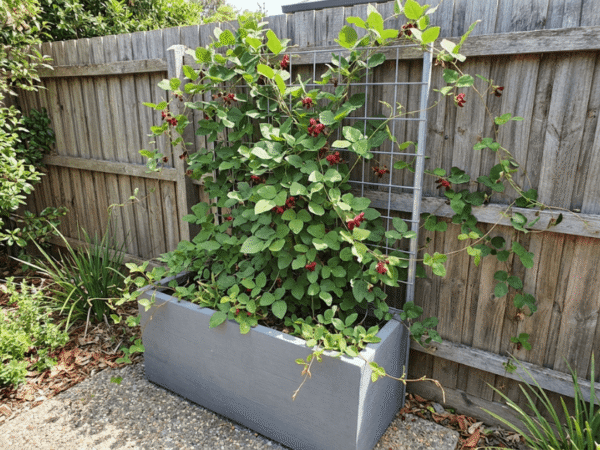
For a native creeper with real vigour and a striking flower, Kennedia rubicunda — commonly called dusky coral pea — is worth considering, though it comes with a caveat: this is a genuinely vigorous, sprawling grower in the ground, and container culture is the sensible way to keep it in check for smaller sites.
Why it works in pots: Confining the roots naturally restrains the exuberant growth that makes Kennedia rubicunda a challenging choice in open garden beds. In a container with a well-secured support, it becomes a manageable, fast-covering vine rather than a groundcover that swallows everything nearby.
The display: Deep red-brown, almost maroon pea flowers appear in spring, distinctive enough to stand out from the purples and creams of the other climbers on this list. The foliage is broad and slightly leathery, giving good year-round coverage.
Growing notes:
- Provide a robust support structure from the outset — this is not a plant for a flimsy trellis.
- Prune hard after flowering to control size and encourage denser regrowth; without this, it can become woody and sparse at the base.
- Excellent drought tolerance once established, making it a strong pick for exposed, low-maintenance commercial applications where irrigation is limited.
- Full sun gives the best flowering and the tightest, most manageable growth habit.
Designing With Native Climbers
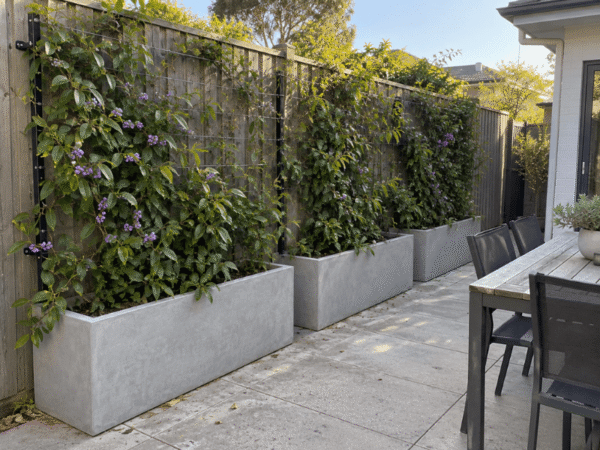
Native vines earn their keep in a design scheme the same way any climbing plant does — by turning a flat, hard surface into something with texture and seasonal change. A few applications worth considering:
Boundary screening. A run of pots along a fence line, each planted with hardenbergia or wonga wonga vine on a shared wire system, creates a green wall without the cost or permanence of in-ground planting — useful for tenanted commercial sites or rental properties where digging up a garden bed isn’t an option. Rectangular trough planters give a cleaner, more continuous line for this kind of run than individual round pots.
Courtyard walls and entryways. Bower vine or native wisteria trained up a wall-mounted trellis brings flower and fragrance to entrances without competing for already-limited floor space — an approach that also works well when using pots and planters on poolside and resorts.
Balcony privacy. Compact hardenbergia cultivars on an obelisk or narrow trellis suit apartment balconies where floor space is tight but height is available.
Habitat and biodiversity briefs. For councils and developers working to a biodiversity or pollinator-friendly brief, a mixed planting of hardenbergia, kennedia, and pandorea species delivers extended flowering across most of the year while staying entirely within an indigenous planting palette.
Common Problems With Potted Native Climbers
- Poor flowering: Usually insufficient light or over-fertilising, particularly with high-phosphorus products. Move to a sunnier position and switch to a native-specific fertiliser.
- Leggy, sparse growth: Almost always a pruning issue. Every species on this list benefits from a proper prune straight after flowering — skipping this for a year or two leads to bare stems low down and growth concentrated at the top.
- Yellowing foliage: Check drainage first. Waterlogged roots are the most common cause of yellowing in native climbers, followed by phosphorus toxicity from the wrong fertiliser.
- Collapsed or sagging vines: Undersized or poorly secured support structures. These plants put on real weight once established — make sure whatever they’re climbing is fixed properly before planting, not added as an afterthought.
Final Thoughts
Native australian climbers don’t need to be treated as a niche or specialist choice reserved for bushland gardens. Hardenbergia, the two pandoreas, kennedia rubicunda, and native wisteria are all genuinely useful, good-looking plants for climbing plants in containers, whether the brief is a private courtyard, a commercial forecourt, or a streetscape planting scheme built around indigenous species. Match the plant to the right pot, give it something proper to climb, and get the pruning timing right, and any of these vines will reward you with years of low-input flowering and coverage — no fussing over soil pH or winter protection required.
0 Comments