

Few climbers earn their reputation quite like star jasmine. Walk past a courtyard in late spring and you’ll smell it before you see it — that heady, sweet fragrance drifting over a fence line or wrapped around a pergola post. Trachelospermum jasminoides, to give it its proper name, has become one of the most requested climbing plants for Australian gardens, courtyards, and commercial landscapes, and for good reason. It’s glossy, it’s fragrant, it’s remarkably tolerant of neglect once established, and — critically for anyone working with limited ground space — it grows just as happily in a pot as it does in open soil.
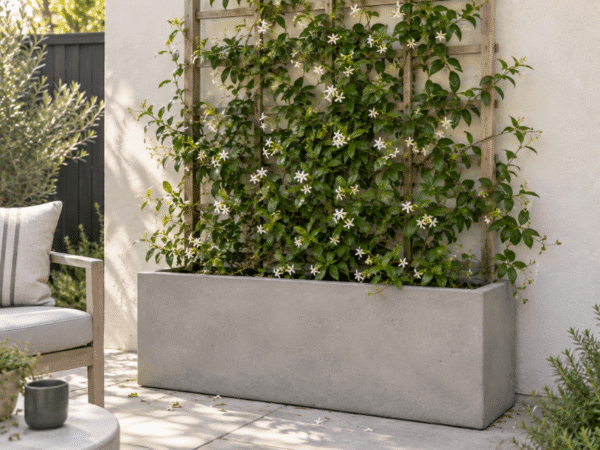
This guide covers everything you need to get star jasmine thriving in a pot, from choosing the right planter through to training it up a trellis and keeping it looking its best year-round. For more container-growing guides across other species, see our Potted Species Growing Guides Hub.
What Exactly Is Star Jasmine?
Despite the name, star jasmine isn’t a true jasmine at all — it belongs to the Apocynaceae family, related to oleander and frangipani rather than the genus Jasminum. The small, star-shaped white flowers and intense perfume are dead ringers for the real thing, which is exactly how it earned the common name. As a plant, it’s an evergreen twining climber with dark green, glossy foliage that stays attractive year-round, with new growth often emerging bronze before settling into deep green. Left unchecked it can climb four or five metres, though it’s easily kept compact in a pot with regular pruning.
It’s also a genuinely versatile plant: trained up a support it becomes a vertical feature, left to sprawl it works as ground cover, and clipped regularly it can even be kept as a rounded shrub without any support at all. Few plants offer that much flexibility from a single species.
Why Grow Star Jasmine in Pots and Planters
Growing star jasmine in pots and planters isn’t a compromise — for many sites, it’s the better option. Courtyards, balconies, and paved commercial forecourts rarely have garden beds to plant into, and a star jasmine planter lets you introduce fragrant, screening greenery anywhere there’s a patch of hard surface and a wall or trellis to climb.
Growing in pots also gives you control. You can position the plant exactly where its scent will be appreciated — beside a front door, along a walkway, near an outdoor dining area — and move it if the light conditions change or the design brief shifts. For rental properties, staged commercial fit-outs, or hospitality projects that need to adapt over time, that flexibility is genuinely useful.
Choosing the Right Pot for Star Jasmine
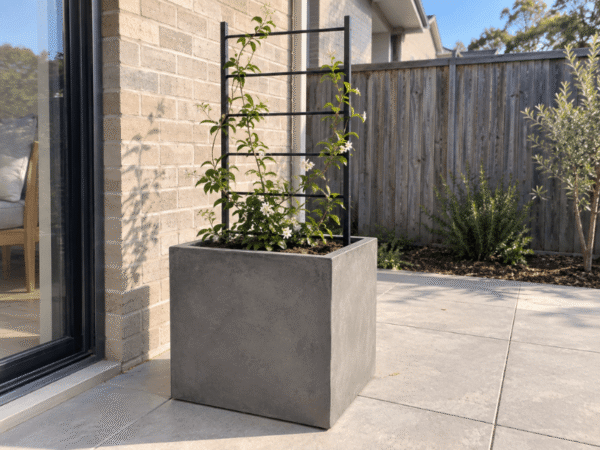
Star jasmine isn’t a fussy plant, but a few pot decisions will make a real difference to how it performs long-term.
- Size: Start with a pot at least 40cm in diameter and equally deep. Star jasmine develops a reasonably substantial root system over time, particularly if you’re training it to cover a large trellis or wall, so undersizing the pot early on tends to mean more frequent repotting down the track.
- Drainage: Non-negotiable. Star jasmine tolerates a wide range of conditions but will not forgive waterlogged roots for long. Make sure the pot has generous drainage holes, and avoid sitting the pot directly in a saucer that collects standing water.
- Weight and stability: Once trained onto a trellis or obelisk, a mature star jasmine carries real weight and catches wind like a sail. A lightweight fibreglass or GRC (Glass Reinforced Concrete) planter with a wide, stable base is a smart choice here — you get the visual heft of concrete without the difficulty of moving a genuinely solid concrete pot once it’s planted and trellised.
- Material and finish: Because star jasmine’s foliage is such a consistent, glossy dark green, it pairs well with almost any planter finish. A matte charcoal or off-white cube planter gives it a contemporary, architectural edge, while a rendered concrete or terracotta-toned pot suits a softer, Mediterranean-leaning courtyard.
If you like this look, our guide to growing agaves in stylish pots covers how the same matte, architectural planters work for sculptural succulents.
Potting Mix and Planting
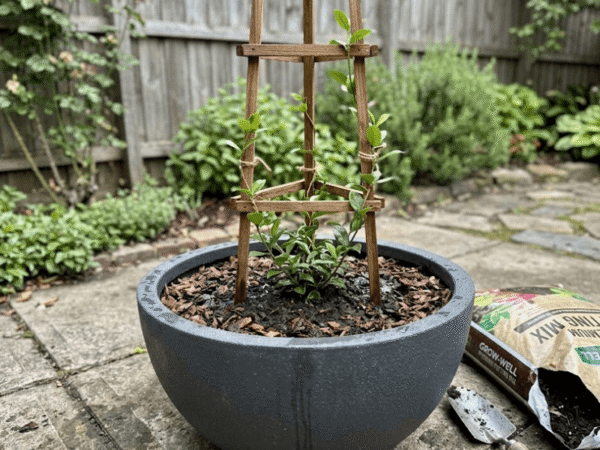
Use a premium, free-draining potting mix rather than garden soil, which compacts in pots and drains poorly. Star jasmine isn’t especially particular about soil pH, performing well across a broad range from slightly acidic to neutral, but it does appreciate a mix with reasonable organic content to sustain vigorous growth.
To plant:
- Fill the base of the pot with potting mix, leaving enough depth for the root ball to sit level with the pot’s rim once in place.
- Position any trellis, obelisk, or support structure before planting where practical — it’s far easier to install support into an empty pot than to work around an established root system later.
- Remove the plant from its nursery pot, gently teasing out any circling roots around the edge of the root ball.
- Backfill around the roots with potting mix, firming gently to remove air pockets, and water thoroughly to settle everything in.
- Apply a layer of mulch to the surface to conserve moisture and moderate soil temperature, keeping it clear of the main stem.
The Star Jasmine Trellis: How to Make It Climb
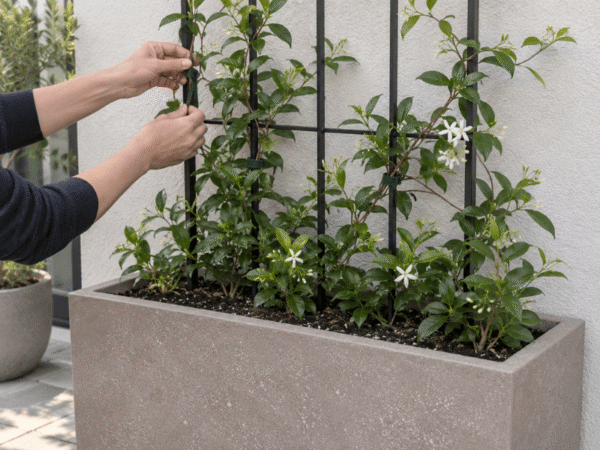
Star jasmine is a twining climber, not a self-clinging one like ivy or climbing fig — it has no aerial roots or adhesive pads, so it needs something to physically wrap around. Against a bare wall with nothing to grip, it will simply flop rather than climb.
Choosing a trellis: A grid or lattice of narrow timber, metal rod, or wire gives the twining stems plenty to grab onto. A simple obelisk or teepee frame suits a potted setting well, while wire and cable fixed to a wall works nicely for espalier-style training against a flat surface.
Star jasmine trellis ideas worth considering for pots and planters include a slim powder-coated steel arch for a narrow balcony, a timber ladder trellis standing in the pot itself, or cable wires run up a wall behind the planter for a nearly invisible support once the foliage fills in.
Training the plant: Gently guide new stems towards the support and loosely tie them in place with soft plant ties, checking every few weeks that ties aren’t cutting into the stems as they thicken. Once a stem contacts the trellis, it will generally begin twining on its own. Be patient in year one — most of the plant’s energy goes into roots, with top growth accelerating noticeably from the second season.
Redirecting growth: Left unchecked, star jasmine will climb past the top of a trellis in search of the next surface. Regular light training and tip-pinching keeps growth contained to the intended support.
Sunlight and Position
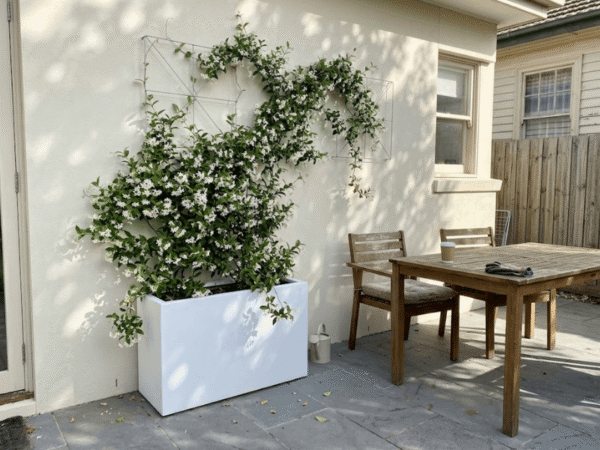
Star jasmine flowers most prolifically in full sun to part shade. Aim for at least four to six hours of sun for the strongest flowering display; a shadier spot still supports healthy foliage, just with a lighter bloom. In harsh, exposed positions — a west-facing balcony in inland or northern Australia, for instance — some afternoon shade helps prevent leaf scorch in summer. Bougainvillea and wisteria are similarly sun-hungry options for the same position.
Watering and Feeding
Established star jasmine is reasonably drought-tolerant in the ground, but potted plants dry out faster and need more consistent attention, especially in their first year.
- Water deeply once the top few centimetres of potting mix feel dry, letting water run freely from the drainage holes.
- Reduce watering over the cooler months as growth slows.
- Feed with a balanced, slow-release fertiliser in early spring, topping up with a diluted liquid feed through the growing season to maximise flowering.
- Avoid high-nitrogen products, which push leafy growth at the expense of flowers.
If you’d rather plant something that barely needs watering at all, agaves are the obvious opposite end of the spectrum.
Pruning Star Jasmine in a Pot
Prune after the main spring flowering flush to shape the plant and remove wayward stems reaching beyond the trellis. Regular tip-pinching through the growing season encourages bushier lateral branching and more flowering wood the following year. Star jasmine is forgiving of a hard prune too — it reshoots readily from older wood, so an overgrown plant can be cut back hard in late winter without lasting harm.
Star Jasmine as a Privacy Screen
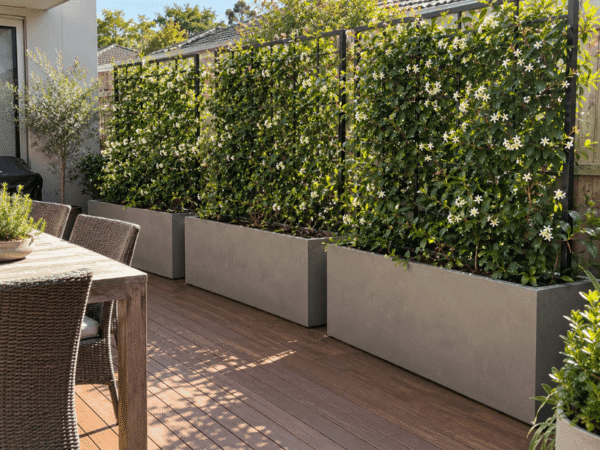
Evergreen, dense once established, and tolerant of heavy clipping, star jasmine makes a popular potted privacy screen for balconies, courtyards, and boundary fences where digging into the ground isn’t an option. A row of matching, trellised planters will knit into a continuous green screen faster than most expect — typically within two to three growing seasons. Space planters roughly 60–80cm apart along the screen line so plants fill their own support without excessive overlap, while still closing any gaps once established. Some gardeners pair star jasmine with bamboo along longer screen lines, using the jasmine’s fragrance and flowering to soften the denser, more architectural look of the bamboo.
For a real-world example of this approach, see how Manhattan Charcoal Tall Troughs were used to screen the walls of a narrow Melbourne CBD courtyard at 99 King Street — eleven tall troughs planted with star jasmine, trained to climb toward a trellis, turning a blank, unused space into a living green border visible from the adjoining boardrooms.
Star Jasmine Across Australian Climates
Star jasmine performs well across most of Australia, which is part of why it’s become such a reliable specification choice for landscape and commercial projects nationally.
- Subtropical and tropical regions (Brisbane, Cairns, Darwin): Thrives with minimal fuss, flowering strongly and growing quickly. Watch for slightly more vigorous growth requiring more frequent pruning.
- Temperate regions (Melbourne, Sydney, Adelaide): Excellent performer, tolerating both warm summers and cool winters. This is arguably where star jasmine looks its best, with strong flowering and steady, manageable growth.
- Arid and semi-arid regions (Alice Springs, inland areas): Manageable with attentive watering and a position offering some relief from the harshest afternoon sun, though it will need more consistent irrigation than in milder climates.
- Cooler regions (Hobart, higher-altitude areas): Generally frost-hardy once established, though young plants benefit from a sheltered position through their first winter or two.
Common Problems and Troubleshooting
Star jasmine is a genuinely low-maintenance plant, but a few issues crop up regularly when grown in pots:
- Yellowing leaves: Usually points to overwatering or poor drainage. Check that the pot is draining freely and that the plant isn’t sitting in standing water.
- Sparse flowering: Typically caused by insufficient light or overfeeding with nitrogen-heavy fertiliser. Move to a sunnier position and switch to a fertiliser formulated for flowering plants.
- Scale insects and mealybugs: Occasionally an issue, particularly in sheltered, warm positions with limited airflow. Treat with horticultural oil or insecticidal soap, and improve air circulation around the plant where possible.
- Slow initial growth: Entirely normal in the first year as the plant establishes its root system. Growth typically accelerates from the second year onwards.
Bringing It All Together
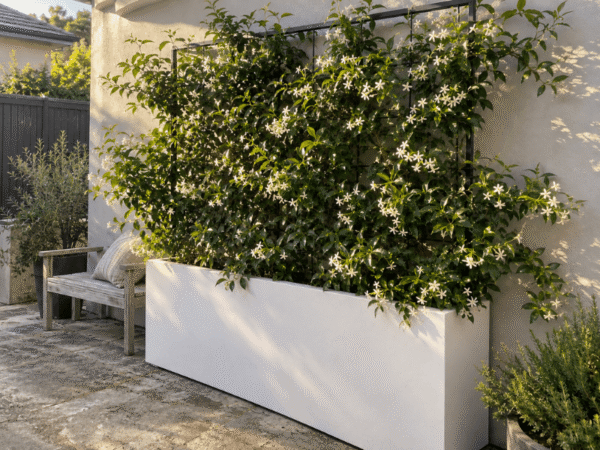
Star jasmine in pots and planters offers something genuinely rare: a plant that’s fragrant, evergreen, visually adaptable, and forgiving of both neglect and heavy-handed pruning in equal measure. Whether it’s trained up a slim trellis to soften a courtyard wall, clipped into a rounded shrub for a formal entrance, or run along a series of planters to build a living privacy screen, climbing star jasmine rewards relatively little effort with a genuinely impressive result.
Get the pot size and drainage right, give it something to climb from day one, and be patient through that first season of root establishment — the payoff, come spring, is one of the most reliably beautiful and fragrant displays available to any Australian garden or courtyard.
For more on choosing the right pot for your climbing and screening plants, browse our pot planting and care guides, or explore our range of planter boxes suited to trellised and screening applications.
0 Comments