

In the quiet corners of a traditional Japanese home, often nestled between wooden walls and paper screens, you might find a small world contained within itself. This is the tsubo-niwa—a courtyard garden of perhaps just a few square metres, designed not for strolling, but for stillness.
This guide is one of many under our Garden Pot & Planter Design Resource Hub.
The word tsubo refers to a small unit of space, enough for two tatami mats, while niwa means garden. It is the art of bringing a complete, symbolic landscape into the most confined of spaces.
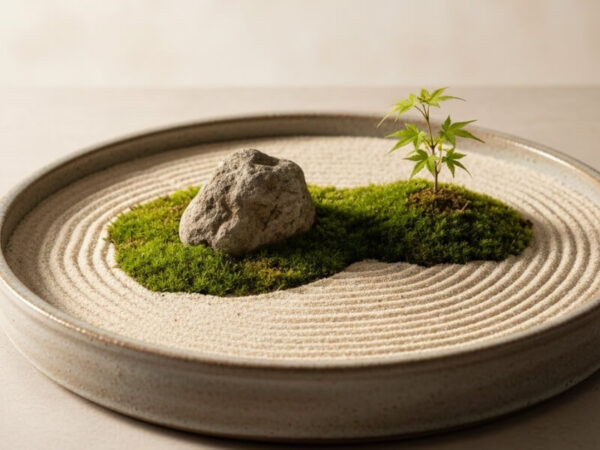
Today, this ancient wisdom translates with exquisite grace to the container garden. It is an invitation, not to fill a pot with plants, but to sculpt a landscape within its confines. A tsubo-niwa in a container asks for our restraint and our intention. It is less about decoration, and more about cultivating a moment of calm—a living haiku composed of moss, stone, and a single, thoughtful gesture of green.
The Quiet Principles: How a Japanese Garden Thinks

To create such a landscape, we first shift our perspective. Japanese garden design is a language of suggestion, where every element carries meaning and quiet speaks louder than noise.
- Asymmetry: Nature is not orderly. A tree does not grow precisely in the centre of a meadow. By placing our elements off-centre, we create a sense of natural, dynamic balance that feels inherently restful to the eye. Learn more about designing with planters here.
- Simplicity (Kanso): This is the art of removing the non-essential. It is a careful paring back until what remains is only what is meaningful. In our container, it means one stunning plant, not five. A single well-chosen stone, not a scattering of pebbles.
- Symbolism: Here, the imagination is invited to wander. A vertical stone becomes a mountain or an ancient tree trunk. Raked gravel or fine sand flows like a river or a still sea. Moss suggests a distant forest or a verdant plain. The container’s edge is not a limit, but the horizon.
- Ma (負): This is the powerful concept of negative space—the purposeful emptiness between objects. It is the pause in music, the margin on a page. In our miniature garden, ma is the blank canvas of gravel, the breathing room around a plant. It is what allows the composition to feel serene, not crowded.
- Wabi-Sabi: Perhaps the most beautiful principle to embrace. It is the acceptance of imperfection, the beauty in the weathered, the irregular, and the modest. A mossy stone, a gnarled branch, a leaf with a gentle flaw—these are not mistakes, but marks of character and the passage of time.
The Vessel as a World: Choosing Your Container

For a tsubo-niwa, the container is the frame of your landscape painting. A shallow, wide pot—often called a suiban or slab pot—works best. It provides the necessary expanse for creating ma and suggests the feeling of a vast horizon. A muted, natural finish—unglazed ceramic in earthy tones, stone-effect, or aged concrete—allows the garden itself to be the focus. The key is proportion: your elements should feel at home in their space, not cramped or adrift. The shape and colour of your vessel have a deeper psychological effect on the viewer than you might expect.
A Simple Recipe for a Tabletop Tsubo-Niwa

This is not a rigid instruction, but a guided meditation in making. Gather your elements as if choosing words for a poem.
You will need:
- A wide, shallow container.
- A handful of gravel or small stones for drainage.
- A fine, well-draining potting mix.
- A bag of fine, pale gravel or coarse sand.
- A patch of moss (sheet moss or cushion moss works beautifully).
- One small feature plant. Consider a dwarf fern (Polypodium), a tuft of dwarf mondo grass (Ophiopogon), a small azalea, or a maple seedling with delicate leaves. Or visit our post on plant selection for more guidance.
- One, perhaps two, interesting stones. Look for shape and texture, not sparkle.
The Steps:
- Lay the Foundation: Cover the drainage hole with a stone shard, then add a thin layer of drainage gravel. Top with potting mix, leaving about a third of the pot’s depth clear for your gravel “sea” or “river.”
- Establish the Land: Do not centre your plant. Imagine your container as a gentle valley. Place your small plant towards the back or side, mounding the soil slightly beneath it to suggest a rising hill. Firm it in gently.
- Place the Stone: This is your mountain. Position it with care near the plant, perhaps as if sheltering it, or standing alone in a distant corner. Let it look as if it has always been there.
- Unroll the Forest: Place your moss around the base of the plant and stone. It acts as a living carpet, tying the composition together. Tuck it in at the edges, but allow it to feel natural, not perfectly trimmed.
- Create the Sea: Carefully cover all remaining soil with your fine gravel or sand. This is your ma, your negative space. You may choose to leave it perfectly smooth, like a calm pond, or gently rake it with a fork or a stick to suggest rippling water. The patterns are a reflection of your own mind on that day.
The Act of Mindful Making
Assemble your garden slowly. Feel the weight of the stone, the cool damp of the moss. Place each element, then step back and observe. There is no “right” answer, only a feeling of balance and calm. This process is itself a form of meditation—a quiet conversation between your vision and the natural forms in your hands. Perfection is not the goal; thoughtful intention is.
The Gentle Art of Care
Your tsubo-niwa asks for little, but rewards close attention.
- Watering: Water the soil beneath the gravel gently and infrequently, only when it feels dry. The gravel surface should remain largely dry to prevent algae.
- Grooming: This is not pruning, but gentle tidying. Remove the occasional fallen leaf. If moss encroaches too far onto the gravel, lift its edge back. If the plant grows, consider that growth as part of its story—only guide it if it begins to overwhelm the landscape.
- Observing: This is the true practice. Notice how the light changes on the gravel in the afternoon. Watch a new frond unfurl on your fern. See the moss green up after a gentle misting. The garden is alive, changing with the seasons. In autumn, a single red leaf on a tiny maple becomes a monumental event.
A Living Ritual
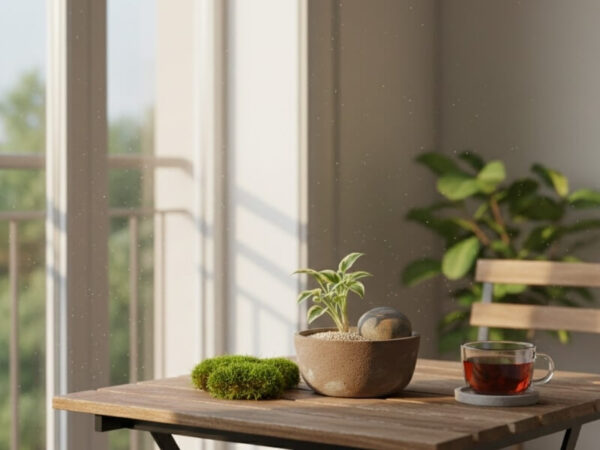
A tsubo-niwa in a container is more than a garden; it is a quiet ritual. It is a reminder that we can hold a landscape in our gaze, and in our care, no matter how small our space. On a balcony, a desk, or a courtyard step, it becomes a portal to stillness.
It teaches us that restraint can be profoundly beautiful, that emptiness holds its own meaning, and that in the patient observation of a miniature world, our own world can seem a little more spacious, a little more serene. In the end, you have not just potted a plant. You have curated a moment of peace—a silent, growing landscape that waits, always, to bring you back to the present.
0 Comments