

For architects, engineers, and builders, specifying site furnishings like planters is far from an aesthetic afterthought; it is a critical structural decision. The choice between traditional concrete and modern glass-reinforced plastic (GRP) planters directly impacts a project’s foundational requirements, safety compliance, installation logistics, and bottom line.
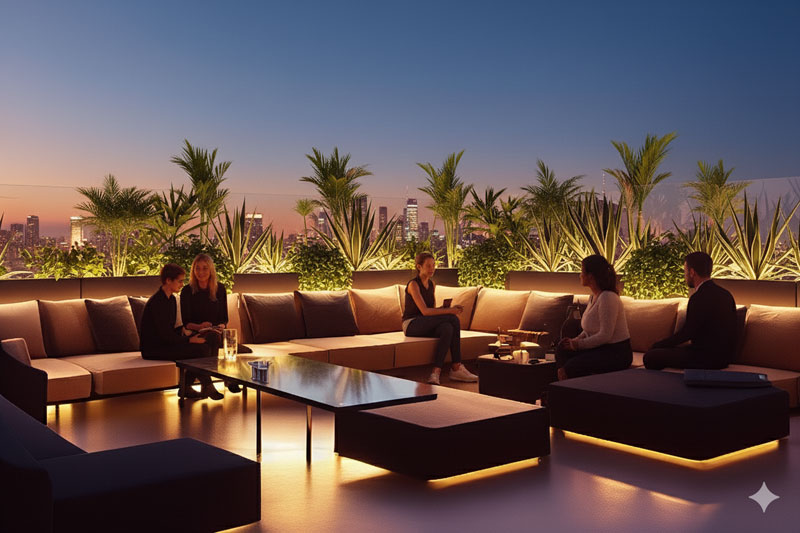
This guide provides a comprehensive, technical analysis of the weight and structural implications of both materials. It demonstrates how fibreglass planters offer a superior, engineered solution for most contemporary applications—particularly elevated decks, rooftops, balconies, and retrofits—by drastically reducing dead load while delivering uncompromising aesthetics and durability.
This guide is a specialized module within our resource hub for working with Fibreglass pots and planters.
The Critical Role of Planter Weight in Structural Design
In structural engineering, every kilogram must be accounted for. The total load on a structure is categorised as:
Dead Load: The permanent, static weight of the building components themselves, including walls, floors, and fixed installations.
Live Load: Temporary, variable loads such as people, furniture, and movable equipment.
Planters, once installed and filled, are considered dead load. While a small pot on a ground-level slab may be negligible, large planters—especially in groups on a suspended slab, rooftop, or balcony—contribute significantly to the load. Underestimating this load can lead to excessive deflection (bending), cracking, and in extreme cases, structural failure.
The total weight of a planter is a sum of its components:
Total Weight = Tare Weight (Planter) + Weight of Soil + Weight of Water (Saturation) + Weight of Plant
This calculation is non-negotiable for ensuring compliance with Australian Standards (AS 1170.1) and guaranteeing the long-term safety and integrity of a structure.

Concrete Planters: The Traditional Weight Benchmark
Concrete has long been the benchmark for a “premium, solid” feel in landscape architecture. However, its weight presents formidable challenges.
Material Properties and Inherent Mass
Concrete is a dense material, typically weighing 2,300 to 2,500 kg/m³. This density is the source of both its perceived durability and its primary engineering drawback.
Detailed Weight Analysis: A Case Study
Let’s analyse a common, popular size: a trough planter with dimensions of 2000mm (L) x 600mm (W) x 600mm (H). This has an internal volume of approximately 720 litres.
Tare Weight of Concrete Planter: A planter of this size, with walls thick enough for structural integrity, will typically weigh between 450 kg and 600 kg.
Weight of Growing Medium: Potting soil weighs approximately 1,300 kg/m³ when dry. For 720 litres (0.72 m³), this adds ~935 kg.
Weight of Water at Saturation: Soil can hold a significant amount of water. Saturation can easily add 25-30% more weight. This adds a further ~250 kg.
Total Estimated Weight: 1,635 kg to 1,785 kg.
This means a single large concrete planter can impose a load of nearly 1.8 tonnes. On a rooftop where multiple planters are used for landscaping, this quickly escalates. Ten such planters would add over 18 tonnes of dead load—a massive burden that must be designed for from the outset.
Structural and Logistical Implications of Concrete
Requires Upfront Structural Reinforcement: The building’s framework, including columns, beams, and slabs, must be designed to carry this immense weight. This often means using more steel reinforcement and thicker concrete pours, increasing material and construction costs significantly.
Limited Application in Retrofits and Elevated Structures: Adding concrete planters to an existing balcony or rooftop often exceeds the original design’s safety factor, making them impractical or requiring expensive and complex structural upgrades.
Complex Installation: Placing a 600 kg empty planter requires heavy machinery like cranes or forklifts. This necessitates clear access routes, reinforces the need for a certified structural engineer to approve lifting points, and increases labour costs and site risks.
Potential for Cracking: While strong under compression, concrete is brittle and can crack from freeze-thaw cycles (in certain climates) or impact during transport and installation.

Fibreglass Planters: The Modern, Engineered Alternative
Fibreglass planters are manufactured using a moulding process where layers of fibreglass matting are saturated with a polymer resin. This creates a monolithic, seamless shell that is incredibly strong for its weight.
Material Properties and Engineered Lightness
GRP is a composite material, combining the tensile strength of glass fibres with the chemical resistance and formability of resin. Its key characteristic is an exceptional strength-to-weight ratio.
Detailed Weight Analysis: The Same Case Study
Using the identical trough planter dimensions (2000mm L x 600mm W x 600mm H):
Tare Weight of Fibreglass Planter: A high-quality, durable fibreglass planter of this size typically weighs between 35 kg and 55 kg.
Weight of Growing Medium & Water: This remains identical to the concrete example, adding ~1,185 kg.
Total Estimated Weight: ~1,220 kg to 1,240 kg.
The Critical Difference: While the total weight is still substantial due to the soil and water, the reduction in the planter’s *tare weight* is revolutionary. The fibreglass planter itself is over 90% lighter than its concrete counterpart. On the same rooftop where concrete planters would be a massive burden to, fibreglass planters, on the other hand, unlock the potential for rooftop landscaping.

Our Fibreglass Range — engineered for strength and UV stability.
Need planters built for tough conditions and commercial use?
Comparative Analysis: The Structural Engineer’s Perspective
This dramatic reduction in tare weight has profound implications across the project lifecycle.
| Feature | Concrete Planters | Fibreglass (GRP) Planters | Implication for Engineers & Builders |
| Tare Weight (2m Trough) | 450-600 kg | 35-55 kg | Fibreglass reduces the permanent dead load by ~500kg per planter before soil. |
| Strength-to-Weight Ratio | Low | Exceptionally High | GRP provides superior impact resistance and durability without the mass. |
| Installation | Requires heavy machinery, craning, complex logistics. | Can often be manoeuvred by 2-3 person crew; no crane required. | Reduces installation cost, time, and risk. Allows for access in constrained sites. |
| Structural Requirements | Significant upfront design and reinforcement needed. | Greatly reduced structural demands; ideal for retrofits and weight-sensitive areas. | Potential for cost savings on the building’s primary structure. |
| Load on Elevated Slabs | Very High. A concern for balconies and rooftops. | Moderate. Primarily from soil/water, which is manageable. | Enables green spaces on structures where concrete planters would be prohibitive. |
| Durability & Longevity | Prone to cracking and weathering over time. | High resistance to weathering, UV (with gelcoat), and impact. Backed by 3-year warranties. | Reduces long-term maintenance and liability. Ensures the specifier’s reputation is protected. |
The “What-If” Scenario: Rooftop Restaurant Fit-Out
Imagine a rooftop bar in Sydney requiring 20 large trough planters to define spaces and provide greenery.
With Concrete: 20 planters × 550 kg (avg. tare) = 11,000 kg of dead load from the pots alone. This likely requires a full structural review and potentially strengthening the slab—a costly and time-consuming process.
With Fibreglass: 20 planters × 45 kg (avg. tare) = 900 kg of dead load from the pots. This is a saving of over 10 tonnes of dead load. The project can proceed with confidence, focusing only on the distributed load of the soil, which the slab was likely already designed to handle.
So this scenario is an example of when to use fibreglass planters.
Scenarios Where Concrete Planters May be the Most Suitable Choice
While fibreglass planters are the superior choice for most architectural and engineering applications due to their weight, there are specific, well-defined scenarios where traditional concrete planters remain the most suitable or even the only viable option.
Here are some key:
1. Ground-Level Installations Where Mass is a Primary Security or Stability Feature
In public spaces, security-conscious areas, and high-traffic zones, the immense weight of concrete is a direct asset, not a liability.
- Hostile Vehicle Mitigation (HVM): Around government buildings, public plazas, or event spaces, concrete planters are used as security bollards to prevent vehicle-ramming attacks. Their mass makes them virtually immovable, providing passive security while contributing to the landscape.
- Crowd Control and Delineation: In transit hubs, stadium entrances, or public squares, concrete planters are used to permanently and clearly define pedestrian pathways, prevent unauthorized vehicular access, and withstand constant, incidental impact from crowds without shifting.
- High-Wind Environments: In exposed, ground-level locations (e.g., coastal promenades, windy hilltops), the ballast provided by a concrete planter is often necessary to prevent tipping. While fibreglass planters can be anchored, a concrete planter’s inherent mass provides a level of stability that is difficult to match without complex anchoring systems.
2. Projects Prioritising “In-Situ” and Sculptural Fabrication
When the design calls for a seamless, monolithic, or uniquely organic form that is part of the architecture itself
- Integrated Landscape Architecture: For designs featuring built-in, poured-in-place concrete planters that are integral to retaining walls, seating (planter walls), or the overall architectural form. In these cases, the planter isn’t an object placed on the structure; it is the structure.
- Custom, One-Of-A-Kind Sculptural Pieces: For high-budget art installations or luxury residences where a specific, non-modular, sculptural shape is required, concrete can be formed and cast on-site or to exact custom specifications in a way that is often more cost-effective than creating a custom fibreglass mould for a single unit.
3. Applications Driven by Maximum Acoustic and Thermal Mass
The high density of concrete gives it properties that are beneficial for specific environmental performance needs.
- Noise Mitigation: Along busy urban roads or highways, massive concrete planter walls can act as effective sound barriers. Their density helps to absorb and block traffic noise more effectively than a thinner, hollow fibreglass shell.
- Thermal Regulation: In passive solar design or greenhouse applications, concrete’s thermal mass can be desirable. It absorbs heat during the day and slowly releases it at night, helping to moderate temperature swings for the plant roots and the immediate microclimate.
4. Specific Aesthetic and Heritage Contexts
In some design contexts, authenticity and patina are the primary drivers.
- Heritage and Restoration Projects: When working on a heritage-listed building or a restoration project where the original specifications called for concrete, using a modern fibreglass replica may be deemed inappropriate. The authentic material, including its tendency to weather and develop a patina over decades, may be a non-negotiable part of the design intent.
- The “Brutalist” Aesthetic: For projects that intentionally celebrate the raw, heavy, and textured nature of Brutalist architecture, only real, unfinished concrete will achieve the desired aesthetic effect. The material is the message.

Addressing Common Concerns and Specifications
Durability and Warranty:
A common misconception is that lightweight means less durable. High-quality fibreglass planters, like those from Sigma, are engineered for commercial use. The UV-stable gelcoat finish prevents fading and degradation, and the inherent flexibility of GRP allows it to withstand knocks and impacts that would shatter concrete. The backing of a robust 3-year warranty provides architects and builders with the certified assurance they need, ensuring the products they specify will last and protect their professional reputation.
Aesthetic Fidelity:
Modern manufacturing techniques allow fibreglass planters to be finished with textures and colours that are virtually indistinguishable from real concrete. The “concrete colour” finish, which accounts for a significant portion of sales, offers the desired urban, minimalist aesthetic without the associated weight penalty.
Stability in Wind:
While lighter, fibreglass planters achieve their stability from the ballast of the soil and water within them. Once filled, they are extremely stable. For exceptionally windy sites, optional anchor kits can be specified to provide absolute security.
Specification and Procurement Best Practices
For professionals specifying planters, the following checklist is recommended:
- Calculate Early: During the design phase, calculate the total dead load of the proposed planters (including soil and saturation) and provide this data to the structural engineer.
- Prioritise Weight Data: Require suppliers to provide accurate tare weights for their products in specification sheets.
- Verify Load Capacity: For elevated applications, confirm the load capacity of the structure with the consulting engineer.
- Choose a Supplier with Stock: For project timelines, specify a supplier like Sigma Planters that holds large quantities of key products (like concrete-coloured troughs) in stock. This avoids the 3-4 month lead times common in the industry, preventing project delays.
- Consider Custom vs. Stock: While custom fibreglass planters are an option for unique projects, they come with 12-week lead times and container-quantity minimums. Where possible, adapt the design to utilise high-quality stock items to keep the project on schedule and on budget.
- Request Samples: A tangible sample is invaluable. It allows the team to verify colour, texture, and finish quality firsthand, ensuring the final product meets the project’s aesthetic vision.
- Conclusion: Making the Informed Choice
The evolution of planter materials from concrete to fibreglass represents a significant advancement in architectural design and structural engineering. While concrete retains a place in certain ground-level applications where its mass is unproblematic, fibreglass is unequivocally the superior choice for the vast majority of modern commercial, hospitality, and multi-residential projects.

By specifying fibreglass planters, architects, engineers, and builders unlock a host of benefits:
- Enhanced Design Freedom: Enable green spaces on weight-restricted structures.
- Reduced Structural Costs: Minimise the need for over-engineering to support planter weight.
- Streamlined Installation and Logistics: Simplify site operations and reduce costs.
- Assured Long-Term Performance: Rely on durable, warrantied products that protect the asset and the specifier’s reputation.
In an era where every design decision is scrutinised for its efficiency, cost, and impact, choosing fibreglass over concrete is not just a practical alternative—it is a professionally responsible specification for creating sustainable, safe, and beautiful built environments.
Click here to explore our full range of Fibreglass Planters!

0 Comments