


In the evolving landscape of our cities and public spaces, a critical yet often delicate design challenge emerges: how do we protect people from vehicle-borne threats without turning our plazas, forecourts, and streetscapes into fortressed, unwelcoming environments? The answer lies not in a retreat to overt, hostile architecture, but in a forward-thinking, integrated approach. Enter the heavy planter – a dual-purpose element that seamlessly marries robust vehicle mitigation with exceptional landscape value and placemaking.
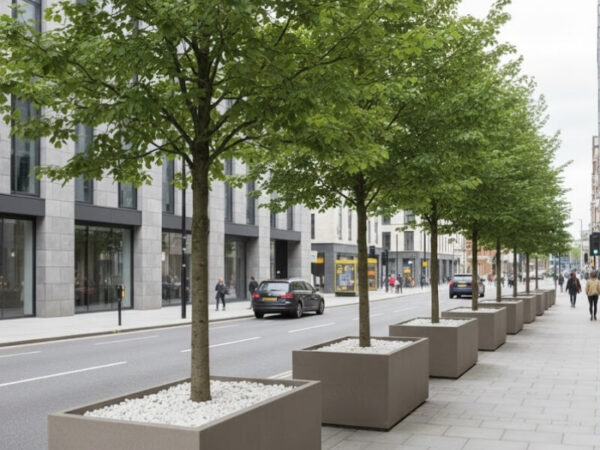
Gone are the days where security meant a sterile ring of concrete bollards. Today’s design philosophy demands solutions that contribute to amenity, soften the built environment, and feel intentional rather than defensive. Heavy planters, when correctly engineered and strategically placed, represent this very ethos. They are a premier example of ‘Security by Design’—where safety is baked into the fabric of the space, enhancing rather than diminishing the public realm.
This guide is included in our Extra Large Planters Resource Hub, alongside other in-depth resources.
How Planters Work as Passive Security Elements
At their core, effective vehicle mitigation relies on physics: mass, inertia, and strategic placement. A suitably engineered planter functions as a substantial, immovable object in the path of a vehicle. Its sheer weight and low centre of gravity resist displacement, absorbing and transferring kinetic energy to slow or stop a threatening vehicle.
Crucially, not all planters are created equal for this role. The decorative terracotta pot or lightweight timber trough will not suffice. Security-grade planters are passive security assets—always present, requiring no activation, and presenting a continuous, uniform line of defence. Their effectiveness stems from deliberate engineering, not happenstance.
Structural Requirements for Security Planters
To be fit-for-purpose, a security planter must be designed and specified with rigour. You cannot simply use any large pot. Here are the key technical considerations for architects and builders.
Mass is Paramount
The empty weight of a planter is just the starting point. Its true performance is calculated on its fully loaded mass: engineered soil, drainage layers, mature plant weight, and critically, the added load of fully saturated soil after heavy rain — which can increase soil weight by 20–30% depending on mix and drainage specification. Minimum mass requirements are defined by a site-specific risk assessment that determines the level of vehicle threat to be mitigated. This figure must be confirmed before procurement, not estimated during installation. For a more detailed analysis, check out our full guide on calculating the fully loaded weight of extra-large planters here.
Material Strength
Not all materials are equal for this task. Common high-performance solutions include:
- Reinforced Concrete Cores: Often considered the gold standard for permanent installations, they offer immense mass and compressive strength. For aesthetics, a finished cladding like stone, brick, or timber can be applied to integrate seamlessly with the surrounding architecture.
- Engineered Composite/Fibreglass Systems: These are high-performance, single-piece units typically built with steel reinforcement. They offer significant mass with more flexibility in shape and design, and are inherently resistant to cracking, weathering, and corrosion with minimal maintenance.
Form and Stability
It’s not just about weight, but how that weight is distributed. A planter with a low centre of gravity and a wide footprint dramatically increases its resistance to being tipped over or pushed. The geometry—often a trapezoidal or flared base that is wider at the bottom—is a critical, deliberate part of the design to maximise stability.
Spacing and Height Requirements
Engineering an individual planter correctly is only half the equation — how planters are arranged together as a barrier line is equally critical. According to the Australian Government’s Hostile Vehicle Guidelines for Crowded Places, the maximum clearance between any two barriers in a line must be no greater than 1,200mm. Gaps wider than this create exploitable openings that a determined vehicle could pass through or target. Equally, barriers must achieve a minimum height of 500mm to present meaningful resistance. A planter that is beautifully engineered but too low or spaced too generously will not perform as a system. These dimensional requirements should be confirmed with your security consultant during the risk assessment phase and locked into the documentation before procurement.
Anchoring vs. Freestanding
For the highest-risk sites, planters may be structurally anchored to a concrete footing for absolute certainty. However, a correctly engineered freestanding solution is often preferred. It simplifies installation, allows for future flexibility in reconfiguring the space, and, when its mass and design are sufficient, can meet required security ratings (like IWA 14-1 & 14-2 (ISO)) without any fixed attachments, blending performance with adaptability.
Professional Coordination
This is non-negotiable. Success depends on early engagement between the entire project team: the architect, landscape architect, structural engineer, and a security consultant. The security consultant defines the level of protection needed, the structural engineer ensures the planter can provide that protection, and the design team integrates it seamlessly into the landscape and architecture. This upfront collaboration prevents expensive and unsightly retrofits later, ensuring the final installation is both rigorously safe and beautifully intentional.
Blending Planters with Conventional Traffic Security Infrastructure
While heavy planters are powerful standalone security assets, their versatility truly shines when integrated with traditional traffic management tools. This “hybrid” approach allows designers to maintain high-level security protocols while using greenery to “mask” or soften the impact of more industrial safety elements.
Decorative Integration with Concrete Bollards
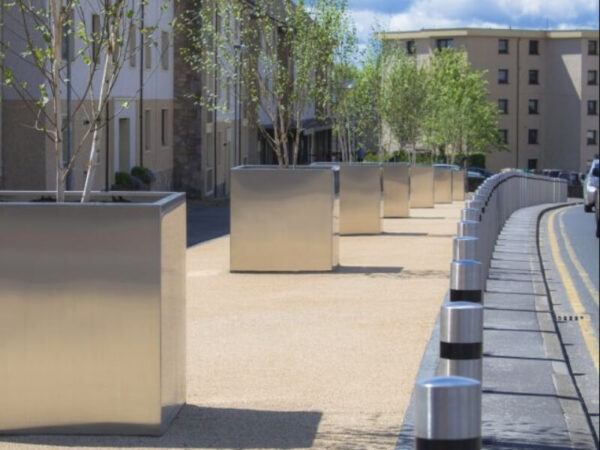
In high-traffic urban plazas, security often requires the foundational strength of reinforced concrete bollards. However, these can appear stark and unwelcoming. As seen in recent municipal upgrades, planters can be strategically placed alongside bollards fitted with decorative covers. By alternating a textured or colored bollard sleeve with a matching low-profile planter, the security line is transformed into a rhythmic landscape feature. The planters break up the “wall of concrete” visual, providing a human-scale element that encourages pedestrians to linger rather than hurry past a perceived barrier.
Shielding Steel Security Poles
For perimeter protection near roadways, vertical steel poles are often necessary for impact resistance. To prevent a “picket fence” of cold metal, large square or rectangular planters can be positioned directly in front of or between these steel posts. This configuration uses the steel for structural stopping power while the planter provides the visual “softening.” This layering ensures that the first thing a visitor sees is a vibrant display of foliage or seasonal flowers, effectively hiding the functional steel infrastructure behind a natural screen.
The “Imaginary Barrier”: Concrete Wheel Stops and Fibreglass
Hybrid security isn’t always about stopping a high-speed impact; it’s often about behavioural psychology and spatial definition.
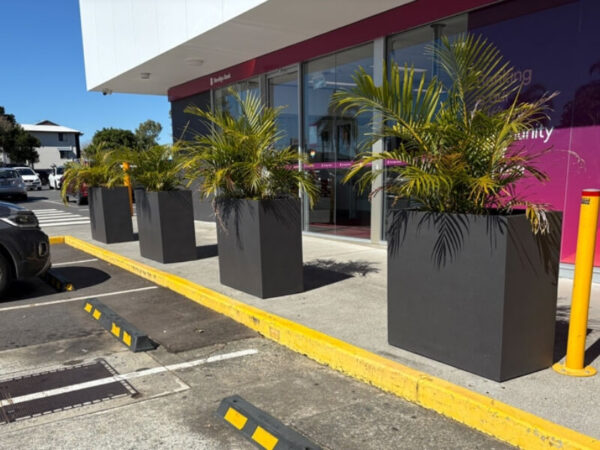
- Concrete Wheel Stops: By placing planters immediately behind standard concrete wheel stops in parking or shared-zone interfaces, designers create a tiered defense. The wheel stop provides a physical “trip” for tires at low speeds, while the planter acts as a tall, visual imaginary barrier that signals to drivers that the area beyond is strictly for pedestrians.
- Reinforced Fibreglass Shells: In scenarios where access is restricted (such as on suspended slabs or podiums), high-performance fibreglass planters offer a unique solution. These shells can be positioned and then internally filled with concrete or heavy ballast. In the event of a vehicle incident, the fibreglass exterior is sacrificial—it does not need to survive the impact. Its sole purpose is to house the mass required to protect pedestrians and provide an aesthetically pleasing “skin” for the heavy core within.
By blending these elements, security becomes a layered narrative. The planter provides the “friendly” face of the perimeter, while the underlying concrete and steel provide the silent, structural peace of mind.
Integrating Security Planters into Design
This is where art meets science. Security planters should not look like an afterthought. They are fundamental urban design tools that can:
- Define Space: Clearly delineate pedestrian zones from vehicle thoroughfares, creating intuitive ‘no-go’ areas for vehicles. See our car park case study on vehicle-pedestrian separation in high-risk contexts: planters turning hostile edges into landscaped pedestrian transitions.
- Enhance Architecture: Be aligned with building grid lines, module rhythms, or entrance sequences, reinforcing the site’s architectural language.
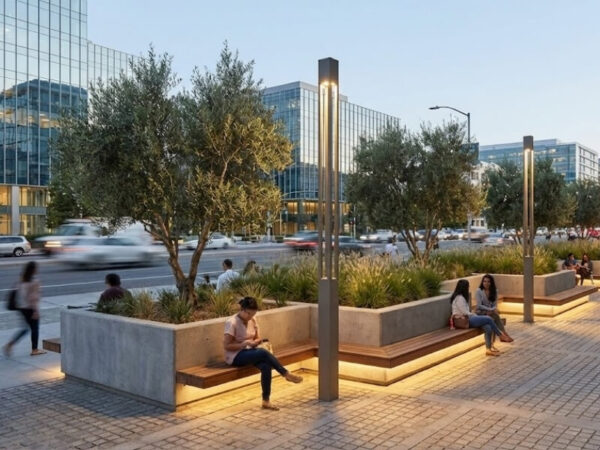
- Create Layered Defence: Be deployed in staggered or offset patterns to channel pedestrian flow while preventing straight-line vehicle approaches. They can be seamlessly integrated with seating, lighting, and canopy trees for a multi-functional streetscape.
- Softening and Greening: This is their superpower. They introduce vital greenery, shade, seasonal colour, and biodiversity. They manage stormwater through soil filtration and contribute to urban cooling.
The goal is a space where security feels inherent, considered, and contributive—a clear perimeter that is also a beautiful, people-focused edge.
Planters vs. Traditional Concrete Bollards: A Holistic Comparison
| Consideration | Traditional Concrete Bollards | Engineered Security Planters |
| Visual & Perceptual Impact | Can be perceived as hostile, sterile, and purely utilitarian. | Soften the landscape; contribute to amenity and biophilia. Seen as an asset, not a barrier. |
| Cost | Lower initial purchase cost. | Higher initial investment, but delivers multiple value streams (landscaping, placemaking). |
| Flexibility & Adaptability | Fixed function. Difficult to relocate; offer no future flexibility. | Can be relocated (if freestanding). The planting can be changed seasonally or as design needs evolve. |
| Maintenance | Virtually none, but offers no ancillary benefits. | Requires horticultural maintenance, which is a public amenity investment. |
| Contribution to Place | Single-purpose: security only. | Multi-purpose: security + greenery + shade + spatial definition + aesthetic value. |
Planters are not merely a substitute for a bollard; they are a holistic upgrade that addresses multiple urban design objectives simultaneously.
Are you specifying for a large-scale commercial or high-exposure project?
Our Extra-Large Planters are engineered for structural integrity and durability.
Best-Practice Collaboration Process
Success hinges on early, cross-disciplinary integration:
- Risk Assessment & Briefing: A security consultant, in tandem with the client and design team, defines the threat level and performance requirements.
- Concept Design: Architects and landscape architects position planters integrally within the masterplan, defining both security zones and landscape outcomes.
- Technical Specification & Engineering: Structural engineers work with specialist planter manufacturers (like Sigma Planters) to develop units that meet the mass, impact, and aesthetic requirements. Loadings, saturation, and footing details are finalised.
- Documentation & Procurement: Detailed drawings and specs are issued for tender, ensuring all contractors understand the performance-critical nature of the units.
- Installation & Planting: Correct handling, placement, and final planting according to the landscape design complete the system.
Conclusion
True security in the public realm should never come at the cost of beauty, accessibility, or community connection. By embracing Security by Design, we can create spaces that are safer, more resilient, and genuinely welcoming.
Large heavy planters sit at the forefront of this philosophy, whether serving as standalone barriers or blending with conventional traffic security infrastructure. By integrating greenery with concrete bollards, steel poles, and wheel stops, we create a layered defense that masks industrial safety elements behind a natural, human-scale aesthetic. These hybrid solutions demonstrate that effective security infrastructure can also deliver greenery, shade, structure, and civic value. They do not merely resist threats—they actively contribute to better urban environments.
By specifying engineered security planters and integrated hybrid systems, we make a confident, design-forward statement: that our communities deserve both uncompromising safety and enduring grace.
0 Comments