


Outdoor space in apartment developments is often limited — but that doesn’t mean it has to feel that way. Whether you’re working with a narrow balcony, a rooftop terrace, a shared courtyard, or a ground-level entrance garden, rectangle planter boxes are one of the most effective tools available to landscape architects and property developers.
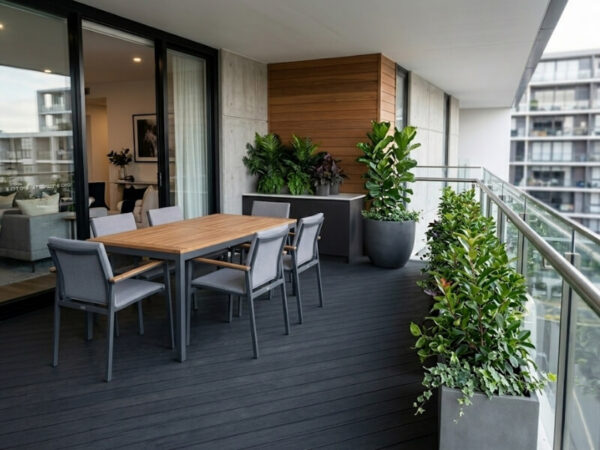
The inherent geometry of the rectangular form is the key. Clean lines and a defined silhouette allow trough planters to slot naturally into corners, run along walls, edge balcony perimeters, and frame pathways — all without consuming the precious floor space that round or freeform containers would sacrifice. Used well, they bring structure, greenery, and a sense of depth to spaces that might otherwise feel like an afterthought.
This guide is part of our Rectangle Trough Planters Resource Hub, alongside other in-depth resources.
Why the Rectangle Works So Well in Apartment Settings
The long and low silhouette of a trough planter excels at defining spaces and creating a sense of direction. This quality is especially valuable in apartment developments, where outdoor areas are often narrow, irregular, or enclosed by hard architectural surfaces on multiple sides.
A row of rectangular planter boxes running along a balcony wall does several things simultaneously: it softens a hard boundary, introduces living greenery, creates a visual rhythm, and — depending on the height and planting — offers a degree of privacy screening. That’s a lot of design work from a single element.
In shared courtyards, the same principle applies. Rectangle planters can be used to delineate zones (i.e. a seating area here, a planting bed there) without the need for built walls or permanent structures. For developers, this kind of flexible infrastructure is a genuine asset, allowing the outdoor layout to evolve as residents use the space.
Design Strategies for Small Outdoor Spaces
Linear Planting Along Walls and Balcony Edges

The most immediate application for rectangle planters in apartment settings is linear planting — running a series of troughs along a wall, fence, or balcony railing to create a green boundary without encroaching on usable floor space. The elongated form of a trough planter is ideal for this: it hugs the perimeter, maintains clear sightlines, and creates the kind of visual rhythm and repetition that gives a space a sense of coherence and intent.
Long and low troughs planted with grasses, low shrubs, or trailing plants are particularly effective here. They bring greenery at eye level — especially when viewed from indoors — and create a soft transition between interior and exterior space that contributes meaningfully to the feel of an apartment.
Creating Privacy Without Walls
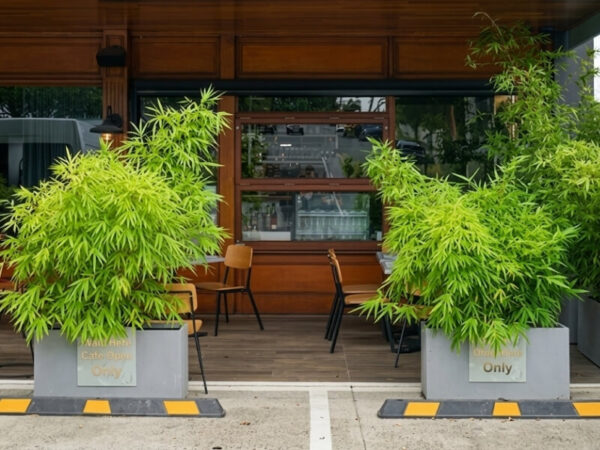
Privacy is a consistent concern in apartment developments, particularly on balconies that overlook neighbouring units or common areas. Tall, slender rectangle planters offer a practical and attractive solution. Planted with ornamental grasses, bamboo, or dense screening shrubs, a row of tall trough planters provides meaningful visual separation without the cost or permanence of a built screen.
The key is proportion: the height of the planter and the plant selection should be scaled appropriately to the balcony depth. A trough that’s too tall in a shallow balcony will feel oppressive; one that’s well-scaled will feel intentional and considered. This interplay of scale and proportion is central to good planter design at any scale.
Tiered Arrangements for Depth and Interest

Where floor space allows a little more flexibility, tiered arrangements of rectangle planters at varying heights create depth and visual interest without requiring a large footprint. Taller planters at the back, lower troughs at the front, and varied widths in between build a layered composition that feels lush and considered rather than crowded.
This approach also maximises planting diversity: different heights suit different plants, allowing a mix of feature specimens, groundcover, and trailing varieties to coexist in a relatively compact area.
Defining Zones in Shared Courtyards
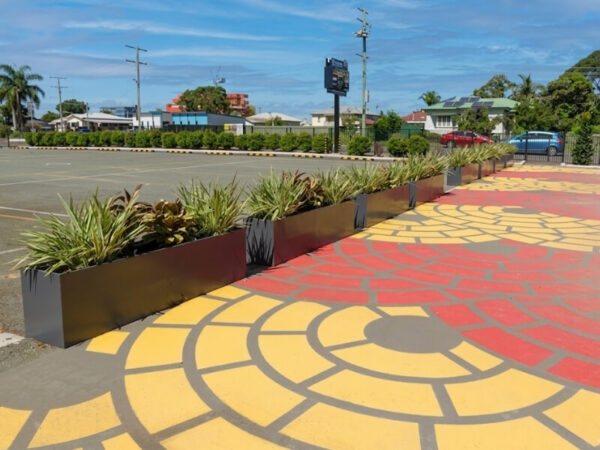
In communal outdoor areas, rectangle planters are an elegant way to create spatial definition without permanent construction. A pair of troughs flanking a seating area signals a distinct space within a larger courtyard. A run of planters along one edge of a path directs movement and creates a sense of arrival. These are the same principles that apply at much larger scales — in commercial streetscaping, for instance — distilled into the more intimate context of residential shared space.
And those are just the basics. Interested in more design ideas using rectangle planters? Head on over to our guide on Creative Ways to Use Rectangular Trough Planters in Urban Commercial Design.
Plant Selection for Compact Planter Boxes
The rectangular form of a trough lends itself particularly well to mass plantings — filling the entire length with a single species for a bold, cohesive effect — or to a considered layering of two or three complementary varieties. In apartment settings, plant selection should balance visual impact with practicality.
Hardy, low-maintenance species are typically the best choice for communal areas where ongoing care may be inconsistent. Ornamental grasses, low-growing native shrubs, succulents, and evergreen groundcovers all perform well in trough planters and tolerate the more exposed conditions often found on balconies and rooftop terraces. Succulents in particular are well-suited to the shallower soil depth of some trough profiles and their drought-tolerant nature reduces watering demands.
For private balconies where residents will manage their own plantings, herbs and edible plants add an appealing functional dimension. A small kitchen garden in a long trough is a genuinely attractive feature that adds tangible lifestyle value to an apartment.
Also, drainage is an important practical consideration regardless of plant selection. Ensure your chosen planters have adequate drainage and that any balcony or terrace installation accounts for water runoff.
Are you specifying for an apartment development?
Our Rectangular Planter Boxes are the perfect design elements for the addition of greenery in limited spaces.
The Broader Value of Green Space in Apartment Developments
Beyond the immediate aesthetic benefits, integrating rectangle planter boxes into apartment developments contributes to the environmental performance of a project. Container plantings help improve local air quality, support urban biodiversity, and contribute to the thermal comfort of outdoor spaces by introducing soft, living surfaces in place of hard paving.
For developers, this matters beyond the environmental credentials. Well-designed outdoor spaces — even small ones — are consistently identified as a key factor in apartment liveability and resident satisfaction. A balcony that feels like a genuine outdoor room, rather than a concrete ledge, changes how people experience their home.
Rectangle planter boxes, chosen for the right environment and planted with care, are one of the most cost-effective ways to deliver that outcome. To see how these principles apply to specific urban environments, read our deep dive on adding greenery to small, limited spaces with rectangle planter boxes.

Getting the Specification Right
If you’re specifying rectangle planter boxes for an apartment development, a few questions will steer you towards the right solution:
- Where will the planters sit? Balcony or rooftop applications require lightweight materials; ground-level courtyards open up the full range.
- What’s the structural loading tolerance? This should be confirmed with your structural engineer before specifying material and size.
- What aesthetic are you working with? Lightweight concrete suits contemporary developments; fiberglass offers more colour flexibility for schemes with a distinct palette.
- Who will maintain the plantings? Low-maintenance plant selections and durable, non-porous planter materials are the practical choice for strata-managed properties.
Sigma Planters’ range includes both fiberglass and lightweight concrete rectangle trough planters across a variety of sizes, with options suited to both residential and high-exposure commercial applications. For bespoke requirements, custom GRC planters are also available. Get in touch with our team to discuss the right solution for your project.
Click here to explore our full range of Rectangular Trough Planters!

0 Comments