


In the competitive world of commercial property, first impressions are currency. A well-maintained landscape signals professionalism, care, and value. However, for facility managers, developers, and property owners, the aesthetic appeal of greenery must be balanced against a sobering financial reality: the long-term cost of maintenance. The initial choice between installing fibreglass planters or traditional in-ground garden beds has profound and lasting implications for a project’s bottom line. This analysis delves beyond the upfront price tag to compare the long-term economics, examining installation, maintenance, plant health, water usage, and flexibility.
The Upfront Investment: Installation and Initial Costs
The most immediate and visible differentiator between the two systems is the initial outlay. This is where in-ground beds traditionally appear to hold a significant advantage, but the reality is more nuanced.
In-Ground Garden Beds
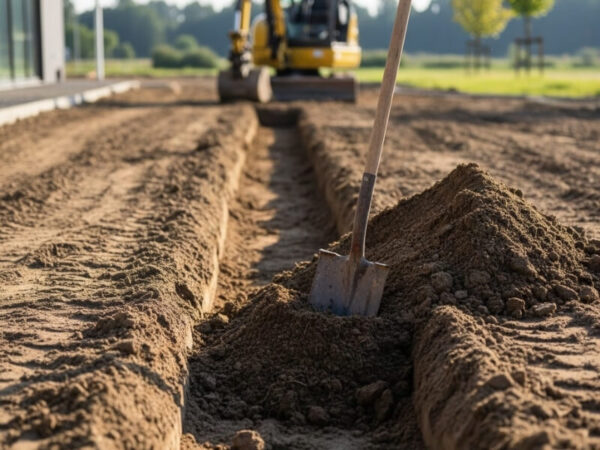
The installation of an in-ground bed is a groundworks-intensive process. It typically involves:
- Site excavation and soil removal.
- Soil testing and remediation, which is often necessary on commercial sites where soil may be compacted, contaminated, or of poor quality.
- The importation of high-quality topsoil and soil conditioners.
- The installation of root barriers and drainage layers if required.
- The planting itself.
While the materials (soil, plants) may seem inexpensive, the labour and machinery costs for earthworks are substantial. The perceived lower cost can be quickly eroded if significant soil remediation is needed.
Fibreglass Planters
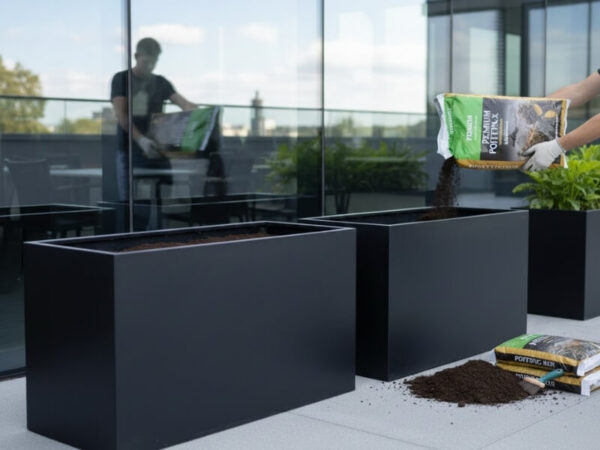
The initial cost for fibreglass planters is more transparent but undeniably higher. You are paying for the manufactured product itself.
However, the installation process is significantly less labour-intensive and disruptive. It generally involves:
- Delivery and placement of the planters in the desired location.
- Filling them with a premium potting mix—a controlled and predictable expense.
- This simplicity leads to faster installation, less site disruption, and lower labour costs, offsetting a portion of the higher product cost.
Verdict: In-ground beds often have a lower materials cost, but fibreglass planters can have a more predictable and sometimes competitive installed cost, especially on complex sites. Planters represent a higher initial capital outlay for a tangible asset.
The Long Game: Maintenance and Labour Costs
This is the arena where fibreglass planters begin to demonstrate their true economic value. Maintenance is the recurring, often escalating, cost that defines the lifetime expense of a landscape.
Weeding and Pest Control
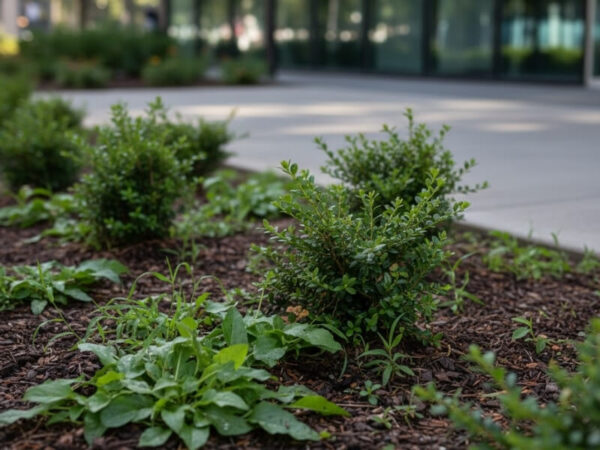
In-Ground Beds: Are in constant battle with the local environment. Weed seeds blow in, and grasses encroach from surrounding lawns. They are also more accessible to pests like snails, slugs, and soil-borne pathogens. This necessitates regular:
- Herbicide application.
- Manual weeding.
- Pest control measures.
Fibreglass Planters: Act as a raised, isolated environment. The use of sterile, bagged potting mix drastically reduces the weed seed bank.
- Weed growth is minimal.
- Pest access is more difficult.
- Maintenance shifts from constant weeding to occasional monitoring.
Plant Health and Replacement Frequency

The health of the plants is directly tied to replacement costs, a significant long-term expense.
In-Ground Beds: Plant health is at the mercy of the native soil. Poor drainage, soil compaction, and pH imbalances can lead to root rot, nutrient deficiencies, and stunted growth. In harsh urban environments, soil can become contaminated with salt or other pollutants, necessitating more frequent plant replacement.
Fibreglass Planters: Offer a controlled root environment.
- High-quality potting mixes ensure perfect drainage and aeration, preventing root rot.
- Nutrient levels can be managed precisely.
- The root zone is protected from external contaminants and soil compaction from foot traffic.
- This superior environment typically results in healthier plants that live longer, directly reducing the frequency and cost of replacements.
Pruning and Growth Management
Plants in the ideal conditions of a planter often grow more vigorously. While this is a sign of health, it can lead to slightly more frequent pruning. However, the ergonomic benefit of working at waist height rather than ground level can make this task quicker, easier, and less physically demanding for staff, reducing labour time and potential injury claims.
Verdict: Fibreglass planters offer substantial and recurring savings in maintenance labour, weed control, and plant replacement costs. The controlled environment is a direct investment in plant longevity.
Water Management: Usage, Efficiency, and Runoff
In an Australian climate, defined by drought and water restrictions, irrigation efficiency is not just an economic concern but an environmental and regulatory one.
Water Usage and Retention
In-Ground Beds: Watering is often inefficient. A significant portion of water is lost to evaporation from the soil surface or percolates deep beyond the root zone. Achieving even water distribution across a large bed can be challenging.
Fibreglass Planters: Are inherently more efficient.
- The limited soil volume means water is focused directly on the root system.
- Modern, self-watering planters take this further, featuring integrated reservoirs that supply water to the plants via capillary action. This can reduce water usage by up to 50% or more by eliminating surface evaporation and runoff.
- This is a crucial advantage during water restrictions, allowing landscapes to remain vibrant while complying with regulations.
Drainage and Stormwater Management
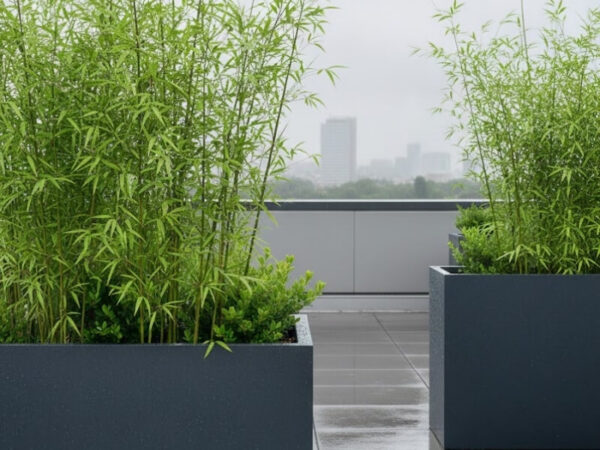
- In-ground beds can contribute to site runoff during heavy rain.
- Planters, particularly self-watering ones, capture and store initial rainfall, actively reducing the volume of stormwater entering municipal systems. This can be a valuable consideration for projects pursuing Green Star or other sustainability ratings.
Verdict: Fibreglass planters, especially self-watering models, are dramatically more water-efficient. The reduction in water bills and compliance security during droughts provides a powerful, long-term financial advantage.
Flexibility, Durability, and Asset Value
The static nature of in-ground plantings is their greatest logistical weakness, while the mobility of planters is a key strategic strength.
Design and Layout Flexibility
In-Ground Beds: Are permanent. Once constructed and planted, any change is a major landscaping project involving excavation, replanting, and remediation.
Fibreglass Planters: Offer unparalleled flexibility.
- They can be rearranged seasonally or for special events.
- They can be easily relocated to accommodate changes in building use, new footpaths, or outdoor dining setups.
- This future-proofs the landscape investment, avoiding costly demolition and reconstruction.
Durability and Longevity
High-quality fibreglass planters are incredibly durable. They are:
- UV-stable, resisting fading and brittleness.
- Weather-resistant, handling frost and intense sun.
- Rust-proof and rot-proof, unlike timber or metal alternatives.
With a typical lifespan of 10 years or more, they are a long-term asset. The initial cost is amortised over a long period of high performance.
Valuing the Asset
- An in-ground garden is generally considered a maintenance item, not a capital asset.
- A fibreglass planter, however, is a tangible, durable asset that can be listed on a company’s balance sheet. Its value extends beyond the plants it contains; it is a piece of landscape infrastructure that can be relocated or even sold if necessary.
The Integrated Cost-Benefit Verdict
Making a purely emotional decision based on the rustic charm of a garden bed is a luxury commercial enterprises cannot afford. The choice must be driven by a clear-eyed analysis of Total Cost of Ownership (TCO).
Choose In-Ground Beds when:
- The project has severe initial budget constraints and the long-term operational budget is secondary.
- The soil quality is already excellent and requires no remediation.
- The design is permanent and will not require future modification.
- The scale is very large (e.g., a parkland setting) where planters would be impractical.
Choose Fibreglass Planters when:
- The focus is on minimising long-term operational and maintenance costs.
- The site has poor, compacted, or contaminated soil.
- Water efficiency and compliance with restrictions are priorities.
- Design flexibility and future-proofing are valued.
- The landscape needs to make an immediate, high-impact statement in areas like building entrances, plazas, and rooftop terraces.
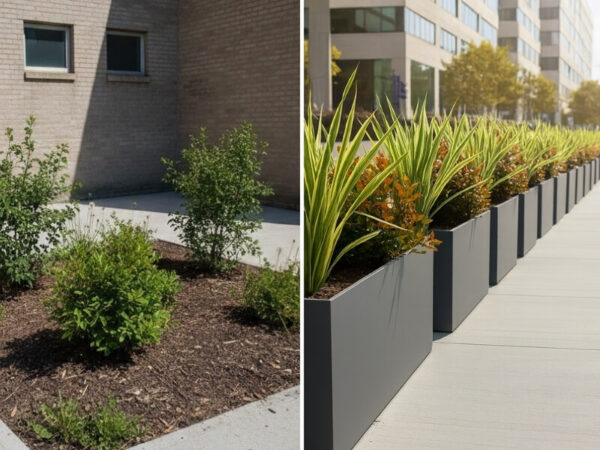
The Way Forward
While the initial invoice for in-ground beds may be lower, it is merely a down payment on a future of higher maintenance labour, water consumption, and plant replacement. The fibreglass planter, with its higher upfront cost, is an investment in efficiency, resilience, and control. It transforms landscaping from a recurring cost centre into a manageable, predictable, and valuable asset. For the astute commercial property manager, the long-term economics are clear: fibreglass planters are not an expense, but a strategic investment in a sustainable, beautiful, and financially sensible landscape.
0 Comments