


For the last decade, biophilic design has been a staple of architectural briefs, yet its execution has often felt like an afterthought—tactical greenery dropped into a static environment. As we move further into 2026, the conversation has shifted from simply adding plants to integrating ecology. This demands a new kind of architectural element: Lightweight Concrete Planters. One that performs structurally, endures climatically, and refines aesthetically while enabling the innovative green spaces that define contemporary practice.
This guide is a part of our comprehensive Lightweight Concrete Planters Guides Resource Hub.
Lightweight Concrete Planters have emerged not merely as a container for soil, but as a critical tool for placemaking, urban cooling, and circulation management. For architects, landscape architects, and asset managers, specifying GRC is no longer just a product choice; it is a strategic decision about how to integrate durable, living systems into the modern architectural envelope.
Here is how this material is redefining the interface between the built and natural environment.
Understanding GRC: The Technical Foundation for Green Integration
To understand the application, one must first appreciate the material science. Glass Reinforced Concrete (GRC) is a composite material consisting of high-strength cement mortar reinforced with alkali-resistant glass fibers. Unlike traditional precast concrete, which relies on heavy steel reinforcement for tensile strength, GRC achieves its durability through a matrix of fibers distributed throughout the material.

Material Composition & Performance Metrics of Lightweight Concrete Planters
GRC typically comprises a cement-rich mortar mixed with alkali-resistant glass fibers at a rate of 3-5% by weight. This combination creates a material with exceptional flexural and tensile strength—typically ranging from 20-30 MPa depending on the specific mix design and fiber orientation. The manufacturing process allows for wall thicknesses as thin as 10-15mm, compared to the 50-100mm required for traditional precast concrete.
This composition yields three distinct advantages for the integration of green spaces in commercial architecture:
- Structural Integrity, Minimal Weight
GRC planters typically weigh 60-80% less than their precast counterparts. A 1200mm x 600mm planter that would weigh approximately 200kg in precast concrete can weigh as little as 50-60kg in GRC. This reduction is critical for podium decks, green roofs, and high-rise terraces where structural loading is a primary constraint. The weight savings open possibilities for innovative greenery in locations previously considered unfeasible for concrete-based planting, including rooftop gardens and upper-level terraces. See our full weight guide for GRC planters here. - Superior Finish Consistency
The spray-up or premix manufacturing processes allow for sharp, crisp edges and a pinhole-free surface finish. This ensures color consistency—whether in neutral Charcoal or warm Ivory tones—across an entire project phase, eliminating the variation often seen in poured-in-place solutions. For specifiers, this means the ability to guarantee visual uniformity across a multi-year, multi-stage development. The surface can be finished to mimic natural stone, polished to a smooth texture, or left with a subtle aggregate exposure depending on the architectural intent. - Climatic Resilience
With low water absorption (typically below 5%) and high resistance to freeze-thaw cycles and UV degradation, GRC is a permanent material. It withstands the rigors of public realm interaction and thermal stress without spalling or fading, ensuring the asset’s visual integrity for decades. In an era of tightening sustainability mandates and extended warranty periods, this longevity is a core performance metric for any integrated green space.
Strategic Applications: From Decorative Object to Integrated Infrastructure
In high-performance commercial, educational, and transport projects, the humble planter must evolve from a decorative object into an element of integrated infrastructure. GRC units are uniquely suited to facilitate this transition. When specified strategically, they begin to perform work beyond horticulture—managing movement, modifying climate, and structuring space while hosting the innovative green spaces that define modern architecture.
1. Circulation Management & Desire Paths using Lightweight Concrete Planters

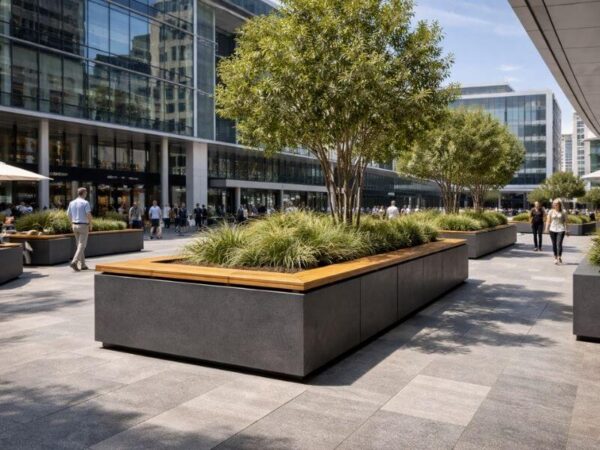
In mixed-use developments, managing pedestrian flow without creating visually obstructive barriers is a persistent challenge. Large-format GRC troughs can serve as elegant bollards or linear guides. Their substantial mass—both real and perceived—intuitively directs foot traffic away from vehicular zones or private terraces while maintaining an open, landscaped feel.
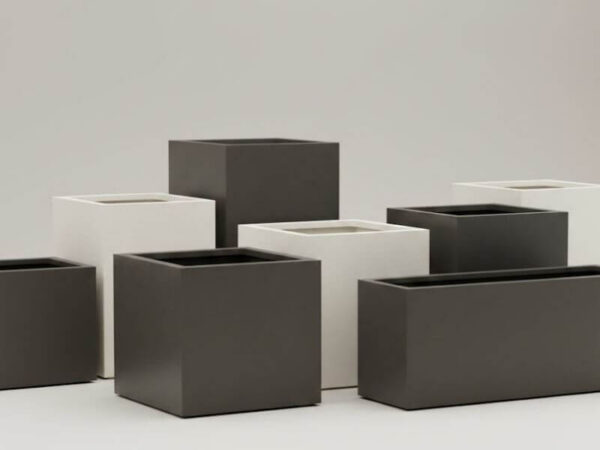
Consider a high-density transit-oriented development where the podium deck must accommodate retail spill-out, pedestrian thoroughfares, and residential privacy simultaneously. A calibrated run of GRC Cubes, set at sitting height, can delineate the retail edge while inviting dwell time. Alternatively, a linear progression of Tall Troughs can guide commuters from station exit to street without a single signpost. The planters become a choreographic tool, using material presence to shape movement naturally while hosting the greenery that softens the urban experience.
Are you specifying for a large-scale commercial or high-exposure project?
Our Lightweight Concrete Planters Range is engineered for maximum tensile strength and UV stability.
2. Urban Heat Mitigation & Social Placemaking at Scale
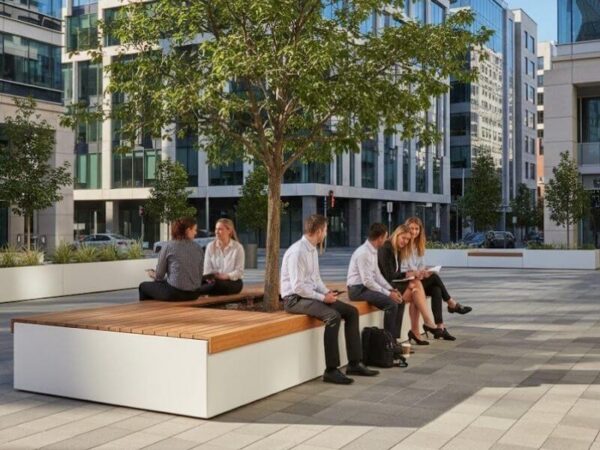
As urban heat island effects intensify, asset managers are tasked with increasing canopy cover and green mass. GRC planters, particularly in larger modules, provide the necessary soil volume for significant tree and shrub planting in hardscaped plazas. Unlike sub-grade planting which conflicts with underground services, these planters allow for mature planting above ground, creating immediate microclimates and shaded seating zones upon project completion.
The most successful applications treat these units as dual-purpose infrastructure. A 900mm-wide GRC trough, specified with an integrated timber cap rail, functions simultaneously as a planter for shade-producing species and as informal seating. In a commercial precinct lunch hour, this detail transforms a thermal mitigation strategy into a social asset—proving that integrated green spaces, when detailed intelligently, are also social infrastructure.
3. Wayfinding & Zoning through Lightweight Concrete Planters Materiality
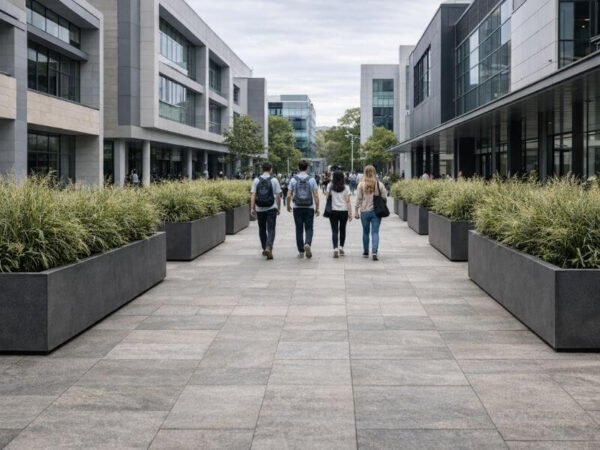
In environments like education campuses or transport hubs, wayfinding is often relegated to signage. GRC planters offer an opportunity for intuitive wayfinding. A consistent palette of forms and colors can delineate quiet study zones, mark primary thoroughfares, or signal a change in program. This use of architectural planting as a spatial language creates a more sophisticated, less cluttered user experience.
A university campus, for example, might deploy a family of forms across its precincts: low, wide Cubes in a consistent finish to define informal gathering nodes outside the student union; tall, slender Troughs to line the primary academic walkway; and a cluster of larger units at major intersections to signal wayfinding thresholds. The material consistency provides visual coherence, while the variation in scale and placement creates an intuitive spatial hierarchy that users navigate subconsciously—all while the planters integrate greenery seamlessly into the architectural fabric.
Sustainability & the Circular Economy
Beyond their immediate functional benefits, GRC planters contribute to broader sustainability objectives that are increasingly central to architectural procurement decisions.
Embodied Carbon Considerations
While concrete has an inherent carbon footprint, the efficiency of GRC manufacturing reduces material usage significantly. A GRC planter uses approximately 80% less raw material than a precast concrete equivalent of the same dimensions. This reduction in material intensity translates directly to lower embodied carbon per unit. When specifying at scale across a commercial precinct, these savings accumulate meaningfully.
Contribution to Green Building Certification
GRC planters can contribute to multiple credit categories within certification frameworks:
- Green Star: Contribute to Urban Heat Island mitigation credits and Landscape design excellence.
- LEED: Support Sustainable Sites credits, particularly around open space and heat island reduction.
- WELL: Enhance Biophilic Design and Outdoor Space Access requirements.
Durability as Sustainability
The most sustainable product is often the one that lasts longest. GRC’s resistance to weathering, corrosion, and physical impact means replacement cycles are measured in decades rather than years. For asset managers, this translates to lower lifecycle costs and reduced maintenance expenditure over the building’s life.
Lightweight Concrete Planters Design Guidance for the Specifier
To maximize the return on investment—both aesthetic and functional—consider these refined parameters when integrating GRC planters into your next modern architectural project.
Contextual Proportioning
Avoid the generic filler planter. Assess the human scale of your space. In expansive commercial plazas, opt for low, wide troughs that function as informal seating, encouraging dwell time. In narrow entryways, verticality draws the eye upward and maximizes greenery without impeding the threshold. The relationship between planter scale and human scale determines whether an innovative green space feels inviting or imposing.
Material Dialogue
GRC acts as a mediating element. Its fine aggregate finish allows it to sit comfortably beside high-end materials like Western Red Cedar, weathered steel, or curtain wall glazing. Use it to ground the transparency of glass or to soften the industrial nature of structural steel. The matte finish of the Charcoal option, in particular, absorbs light and reduces glare, acting as a neutral anchor for vibrant planting. The planter should never compete with its surroundings—it should elevate them while enabling seamless green integration.
Integrated Systems: Drainage & Irrigation
Modern GRC planters can be specified with integrated technical features that enhance performance and reduce maintenance. Consider specifying:
- Reservoir systems: Built-in water storage layers that reduce irrigation frequency and support plant health during dry periods.
- Hidden irrigation: Pre-installed drip lines or capillary matting that eliminate visible pipes and simplify maintenance access.
- Overflow protection: Concealed drainage outlets that prevent water damage to surrounding hardscape.
Lighting Integration for Nighttime Activation
In commercial precincts, the activation of outdoor spaces after dark is critical to vibrancy and perceived safety. GRC planters can accommodate integrated lighting in several ways:
- Up-lighting: Recessed fixtures at the planter base to illuminate feature trees and create dramatic shadows.
- Path lighting: Integrated low-level lights within the planter edge to guide pedestrians along key routes.
- Accent lighting: Grazing lights that highlight the planter’s texture and form while contributing to ambient illumination.
To learn more about lighting integration, visit our specialized guide for planter lighting here.
Planting as Architecture
The planter and the planting must be specified in tandem. For a living architecture effect, avoid sporadic, high-maintenance annuals. Instead, specify structured planting schemes:
- For Screens: Use tall, dense grasses or pleached hedging in Tall Troughs to create instant privacy between alfresco dining areas.
- For Focal Points: Use single-specimen feature trees in large Cubes to create green art pieces within a retail environment.
- For Texture: Layer succulents and groundcovers to complement the planter’s geometric lines, emphasizing the contrast between organic form and manufactured precision.
A Future-Proofed Asset
The specification of GRC planters signals a move toward a more durable and intentional form of green infrastructure. It acknowledges that the spaces between buildings are not voids, but opportunities—zones that require the same design rigor as the structures themselves. In modern architecture, the most innovative green spaces are those that feel inevitable, as though they could never have been anything else.
As urban density increases and climate challenges intensify, the integration of robust, permanent greenery is no longer optional. It is a baseline expectation of high-performance architecture. Materials that offer the permanence of concrete with the flexibility of design enable landscapes that are not just sustainable, but truly livable.
For developers and architects, the choice is clear: when the landscape must last as long as the building, GRC provides the essential envelope for nature to thrive—creating innovative green spaces that define modern architecture for generations to come.
These principles are validated by the American Society of Landscape Architects’ Climate Action Guide —a resource for specifying resilient materials and climate-responsive landscapes.
Explore how our range of GRC planters can support your next architectural application. Contact our team for specification assistance and material samples.
Click here to explore our full range of Lightweight Concrete Planters!

0 Comments